
As industrial facilities continue to imp
Selecting suitable cooling tower fill me
How Cooling Tower Fill Design Affects En
Partial cooling tower fill replacement is common in industrial facilities. When only one section is damaged, replacing the entire fill system may appear unnecessary.
However, installing new fill beside older modules introduces a technical question that is frequently overlooked: will the different sections behave consistently under the same operating conditions?
Two fill products may occupy similar installation spaces while having different internal channel structures. These differences can influence airflow resistance, water distribution, and the way individual sections contribute to cooling performance.
Cooling tower fill is often described using width, length, thickness, and material.
These dimensions are essential for installation, but they do not fully describe the internal geometry.
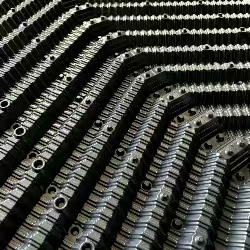
Corrugation pitch, sheet orientation, and channel configuration determine how air and water move through the fill.
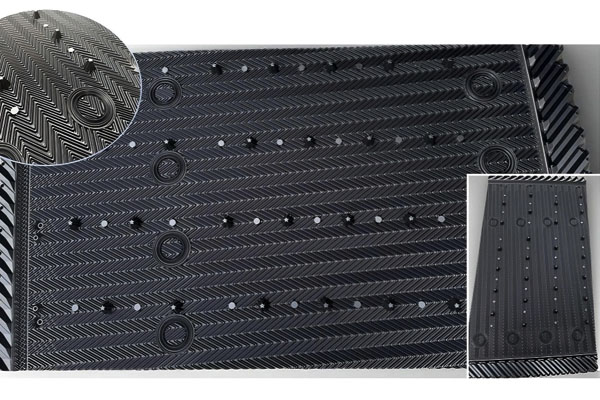
For example, multi-width cooling tower fill with 18mm pitch and 5.5° corrugation represents a defined structural arrangement that should be evaluated against the existing fill configuration.
A different pitch or corrugation arrangement should not automatically be considered equivalent simply because the external dimensions are similar.
Airflow through a cooling tower depends on the combined resistance of the fill, drift eliminators, air inlets, and other internal components.
If adjacent fill sections have substantially different resistance characteristics, air may not distribute evenly across the available area.
The actual effect depends on the tower geometry, fan arrangement, operating airflow, and the extent of the replacement.
Uneven airflow can reduce the effective use of some fill sections, particularly when water distribution is also inconsistent.
This does not mean that every partial replacement will cause a performance problem. It means that structural compatibility should be considered before combining different fill designs.
Before replacing individual sections, contractors should identify the original fill structure as accurately as possible.
Useful information includes:
When the original fill specification is unavailable, a physical sample can help the manufacturer evaluate potential replacement options.
For installations requiring different width arrangements, 18mm pitch cooling tower fill with multiple width options may provide a useful reference during dimensional and structural comparison.
Replacing an entire fill section may be more practical when the existing material has deteriorated unevenly or when the original structural specification cannot be reliably matched.
However, the decision should consider the condition of the remaining fill and the expected service requirements of the tower.
If only a small number of modules are damaged and compatible replacements are available, localized replacement may remain a reasonable solution.
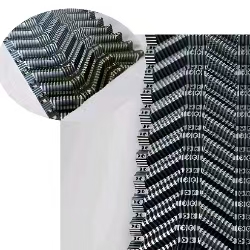
Where the existing tower uses a double-wave arrangement, cross-flow cooling tower fill with double-wave design can be evaluated as a structural reference rather than assuming that a conventional corrugation pattern will provide identical behavior.
After partial replacement, contractors should inspect the installed fill for gaps, incorrect orientation, and interference with nearby components.
Where operating measurements are available, comparing water temperatures, flow conditions, and fan operation under reasonably similar loads can help identify unexpected changes.
Any performance comparison should account for changes in ambient wet-bulb temperature and operating conditions.
Partial fill replacement can reduce material costs and maintenance downtime, but it requires more than matching external dimensions.
Internal structure and airflow compatibility deserve careful consideration, especially when new modules will operate beside older fill.
Identifying the existing corrugation arrangement and discussing replacement options before production can help contractors avoid unnecessary performance uncertainty.
Industry trends and cooling tower fill media insights for global customers.
As industrial facilities continue to improve energy efficiency and equipment reliability, cooling to

Why Mixed Cooling Tower Fill Modules Can Create Hidden Airflow ProblemsPartial cooling tower fill re
Connect with our team for cooling tower fill media details, project information, and technical assistance.
Chat on WhatsApp