
As industrial facilities continue to imp
Selecting suitable cooling tower fill me
How Cooling Tower Fill Design Affects En
When comparing cooling tower media, buyers often pay close attention to corrugation pitch.
A smaller pitch may appear to offer more surface area within the same space, so it is tempting to assume that tighter channels always provide better cooling.
In practice, the relationship is more complicated.
The fill must provide sufficient water-air contact while allowing the tower to maintain the required airflow.
Increasing the available surface area is not useful if the resulting structure creates excessive resistance or becomes difficult to maintain.
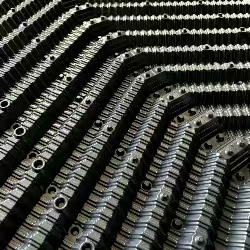
Corrugation pitch influences the internal channel geometry of structured fill.
Depending on the complete sheet design, changing the pitch may affect water distribution, airflow resistance, and the amount of surface available for heat transfer.
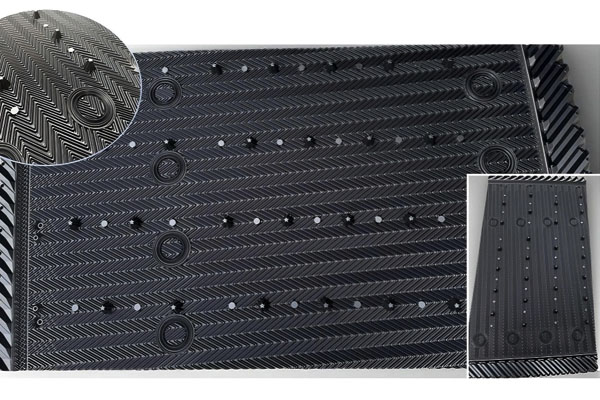
For example, 16.5mm multi-width cross-flow fill represents one particular geometry that should be evaluated within its intended tower arrangement.
A different pitch does not automatically mean better or worse performance.
The complete corrugation profile, sheet spacing, airflow conditions, and water loading all matter.
Where circulating water contains suspended solids or forms deposits, narrow passages may become progressively restricted.
As deposits accumulate, the available airflow area can decrease.
Water distribution may also become less uniform if the internal passages are partially blocked.
This is why I would never select fill solely from a surface-area figure without reviewing the water conditions.
A structure that performs well in a clean-water application may require more frequent maintenance in a system with persistent fouling.
The direction and angle of the corrugations influence the path through which water and air move inside the media.
Different designs may encourage different water distribution patterns and produce different airflow resistance characteristics.
For example, 18mm pitch cooling tower fill with multiple width options can be considered when evaluating a particular channel geometry and installation size.
However, corrugation angle and pitch should be assessed together rather than treated as independent performance indicators.
Double-ripple fill designs introduce another geometric arrangement.
The additional changes in surface shape may influence how water spreads through the media and how air passes through the channels.
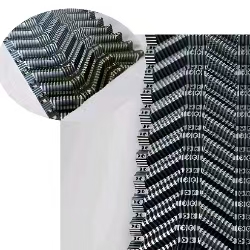
For example, 1200mm double-ripple cooling tower fill is a relevant product to examine when comparing different corrugation structures.
But the term "double-ripple" should not be interpreted as a guarantee of higher thermal performance.
The actual result depends on the complete fill geometry and the operating conditions of the tower.
If a customer asked me to compare two cooling tower fill structures, I would begin with the tower's operating requirements.
I would want to know the circulating water flow, entering and leaving water temperatures, design wet-bulb temperature, and available airflow.
I would also ask about water quality, existing deposits, and the maintenance history of the tower.
Only after reviewing those conditions would I compare the proposed fill geometries.
For a replacement project, the existing support arrangement and available installation dimensions must also be considered.
Don't choose cooling tower media simply because one product has a smaller corrugation pitch or a more complicated surface pattern.
A suitable fill structure must balance heat transfer requirements, airflow resistance, water distribution, and long-term maintenance.
If you're comparing different fill profiles, provide the manufacturer with the tower's operating conditions and existing media dimensions.
That information is far more useful than asking which corrugation pattern is the most efficient without specifying the application.
Industry trends and cooling tower fill media insights for global customers.
As industrial facilities continue to improve energy efficiency and equipment reliability, cooling to

Cooling Tower Media Selection: Why More Corrugations Do Not Always Mean Better CoolingWhen comparing
Connect with our team for cooling tower fill media details, project information, and technical assistance.
Chat on WhatsApp