
As industrial facilities continue to imp
Selecting suitable cooling tower fill me
How Cooling Tower Fill Design Affects En
When ambient temperatures approach freezing, the operating priorities of a cooling tower change. The same cooling tower fill that performs well under summer conditions may face very different risks in winter, including ice accumulation, restricted airflow, uneven water distribution, and freeze-thaw stress.
The key issue is not simply that the air becomes colder. Cold air can actually increase the tower's heat-rejection potential. The problem begins when freezing conditions disturb the designed relationship between water flow, air flow, and fill geometry. Once ice starts restricting air passages or interfering with water distribution, the tower can lose part of the performance advantage provided by the colder ambient air.
For this reason, winter preparation should focus on the complete fill system rather than treating material selection as the only solution.
In a counterflow tower, warm circulating water moves downward while cold air moves upward through the fill. During freezing conditions, ice can develop where cold air enters the tower and around areas exposed to continuous water and airflow.
As ice accumulates, the open passages inside the fill can become partially blocked. This increases airflow resistance and may also disturb the distribution of water through the fill. If the problem continues, the tower may experience uneven cooling and increased mechanical loading on the fill and supporting structure.
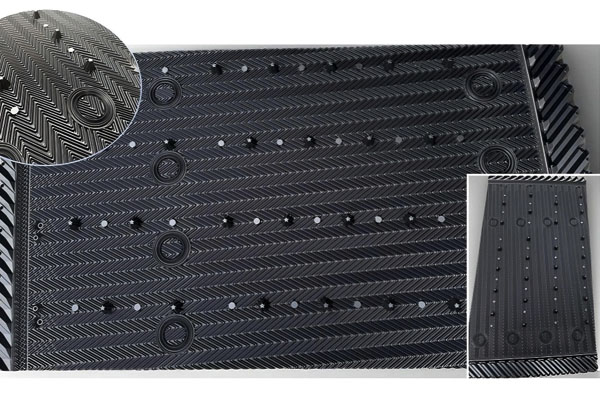
For replacement projects involving counterflow towers, fill selection therefore needs to consider more than heat-transfer performance. The replacement must also match the existing tower dimensions, support arrangement, water distribution system, and operating conditions. This is particularly important when the same fill configuration may be used across different tower designs. A 750/930mm Cross-flow/Counter-flow Fill can be relevant where the project requires a standardized fill size compatible with either crossflow or counterflow replacement applications.
Crossflow towers introduce a different airflow pattern. Air enters horizontally through the fill while water moves downward. In cold weather, the air-entry side of the fill can become particularly important because continuous exposure to cold ambient air increases the possibility of localized ice accumulation.
If ice begins to bridge across the fill passages, the effective air passage becomes smaller. This can gradually increase airflow resistance and reduce the amount of fill area that participates effectively in heat transfer.
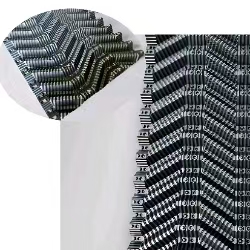
This makes fill geometry an important consideration for winter operation. A Cross-flow Cooling Tower Fill (Double-wave Design) is designed specifically for crossflow cooling tower applications, where the relationship between the corrugated fill surface, water distribution, and horizontal airflow needs to be maintained.
The point is not that a particular fill structure can completely prevent freezing. No fill geometry can eliminate the effect of severe freezing conditions by itself. The purpose of selecting the appropriate structure is to maintain the intended water and air paths as reliably as possible under the tower's actual operating conditions.
Material selection also deserves attention, but it should be considered together with fill structure and operating conditions. PVC and PP are both widely used for cooling tower fill, and their suitability depends on factors such as operating temperature, water chemistry, mechanical loading, installation conditions, and the expected freezing environment.
Freeze-thaw cycling is particularly important. Water remaining inside or around the fill can freeze and expand, while repeated thawing and refreezing can place additional stress on the fill structure and supporting components. The risk is therefore not determined by ambient temperature alone.
For replacement projects, engineers should confirm the actual operating conditions with the fill supplier rather than selecting material solely from a generic temperature rating. A technically suitable tower fill should provide the required mechanical performance while remaining compatible with the tower's water quality and operating environment.
When winter icing is a known operating risk, fill geometry becomes part of the engineering discussion. Narrow passages may become restricted more quickly when ice accumulates, while a more open structure may provide greater tolerance to localized blockage. However, increasing openness can also affect heat-transfer characteristics and pressure drop.
This is why there is no universal “winter fill” that should be installed in every cooling tower. The correct configuration depends on the tower type and its design operating point.
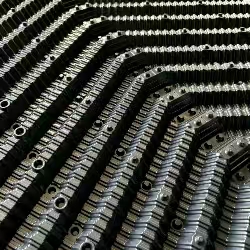
For crossflow replacement projects, dimensional compatibility is equally important. Existing towers may require different fill widths depending on the available installation space and original design. A Multi-Specification Cross Flow Cooling Tower Fill is useful in this type of application because different width options can be considered when the replacement fill needs to fit an existing crossflow tower rather than being selected as a generic standard block.
The practical lesson is simple: before changing fill dimensions to deal with winter conditions, engineers should confirm that the new configuration still works with the tower's water distribution, support structure, airflow requirements, and available installation space.
One of the common misunderstandings about winter operation is that lower ambient temperature automatically means better cooling performance. In principle, colder air provides a stronger temperature difference for heat rejection. In practice, however, ice accumulation can reduce the effective airflow and usable fill surface.
Once the air passages become restricted, the tower may no longer operate according to the original design conditions. Water can also become unevenly distributed when sections of the fill are blocked or when ice changes the local flow path.
Therefore, winter performance should be evaluated by monitoring actual tower conditions rather than relying only on ambient temperature. Cooling-water temperature, water distribution, airflow, fan operation, and visible ice accumulation all provide useful information about whether the fill is operating normally.
When replacing fill in a cooling tower that operates through winter, provide the supplier with as much information as possible. The basic information should include the tower type, existing fill dimensions, material, fill arrangement, water flow, operating water temperature, and expected ambient conditions.
For a replacement project, the existing fill dimensions are particularly important. Width, length, thickness, pitch, support spacing, and installation height can determine whether the new fill can be installed correctly without modifying other tower components.
If the tower has experienced repeated winter icing, the supplier should also understand where the ice normally develops and whether the problem is associated with the fill, water distribution, airflow, louvers, or operating control. Changing the fill without identifying the actual cause may simply move the problem somewhere else.
The objective of winter maintenance is not necessarily to eliminate every trace of ice. The more important goal is to identify abnormal accumulation before it develops into a major airflow, water-distribution, or structural problem.
When a cooling tower repeatedly suffers from winter icing, replacing the fill should be treated as an engineering review rather than a simple product purchase. Start by identifying the tower type and the location of the ice problem. Then check whether the existing water distribution and airflow conditions are consistent with the original design.
Only after those factors are understood should the replacement fill be selected. The material, fill geometry, dimensions, pitch, and installation arrangement should all be evaluated together.
This approach is especially important for industrial cooling towers, where an incorrect fill configuration can affect not only cooling performance but also fan operation, water distribution, maintenance requirements, and the service life of the tower components.
Winter operation creates a different set of requirements for cooling tower fill. The main challenges are not simply low temperature, but the interaction between freezing water, cold airflow, fill geometry, water distribution, and tower operation.
For counterflow and crossflow towers, the correct replacement fill should be selected according to the actual tower structure and operating conditions. Material, dimensions, fill geometry, and installation compatibility all matter. Products designed for specific crossflow or crossflow/counterflow applications can be considered when their structure and dimensions genuinely match the technical requirements of the project.
The best winter strategy is therefore not to search for a fill that is simply marketed as “winter resistant.” It is to select a fill configuration that is technically matched to the tower, understand where freezing occurs, and maintain the system before ice accumulation develops into a larger cooling or structural problem.
Industry trends and cooling tower fill media insights for global customers.
As industrial facilities continue to improve energy efficiency and equipment reliability, cooling to
Winter Operation: Cooling Tower Fill Challenges and Cold-Weather AdaptationsWhy Winter Changes the R
Connect with our team for cooling tower fill media details, project information, and technical assistance.
Chat on WhatsApp