
As industrial facilities continue to imp
Selecting suitable cooling tower fill me
How Cooling Tower Fill Design Affects En
One question comes up regularly when buyers contact a cooling tower fill factory:
"Can you manufacture this size?"
The answer depends on which dimension needs to change.
Some adjustments are relatively straightforward when the factory already has a suitable sheet profile. Others involve the forming mold and cannot be handled by simply cutting the material differently.
Understanding that distinction can save time when preparing an international cooling tower fill order.
In many fill products, the sheet length can be adjusted during production or finishing, provided the forming equipment and product design allow it.
Pack thickness may also be adjusted through the number of sheets or the assembly arrangement.
Changing the corrugation pitch is a different matter.
The pitch is formed by the tooling, so producing a different profile may require an existing alternative mold or additional tooling.
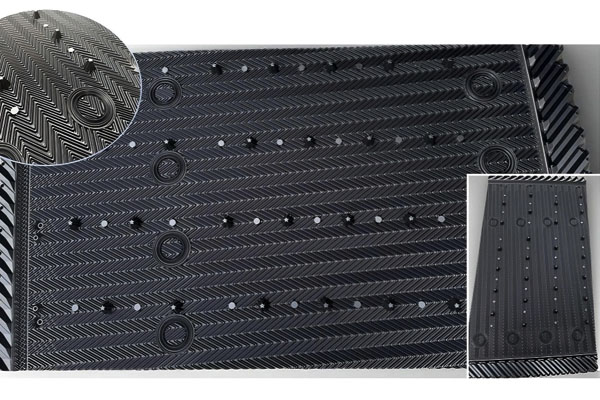
For example, 15mm pitch cooling tower fill for wide crossflow arrangements represents a specific corrugation configuration.
If a project requires a different pitch, the factory should first confirm whether a suitable mold is already available.
Buyers sometimes assume that any requested sheet width can be produced without affecting the manufacturing process.
In practice, the available forming width and mold geometry place limits on what can be produced directly.
A factory may offer several established width options using existing tooling.
For instance, cooling tower fill in 500mm, 625mm, and 750mm widths provides defined size options that can be compared with the customer's required installation dimensions.
If the required width falls outside the available range, the next question is whether the tower layout can accept another arrangement or whether different tooling is necessary.
That decision should be made from the installation drawing, not from manufacturing convenience alone.
Thickness is another specification that deserves attention.
When plastic sheets are thermoformed, the material stretches as it follows the mold profile.
As a result, the local thickness of the formed sheet may differ from the original flat material.
Before approving production, the buyer and manufacturer should agree on the thickness definition and measurement method.
Otherwise, two quotations using the same nominal thickness may not describe exactly the same product.
PVC, CPVC, and PP are commonly discussed for cooling tower fill applications, but their processing behavior and operating characteristics differ.
A sheet profile suitable for one material should not automatically be assumed suitable for another without manufacturing verification.
The operating water temperature, chemical exposure, and mechanical requirements should be reviewed before selecting the material.
If a project involves unusually high temperatures or aggressive water conditions, those details should be provided before the factory confirms production feasibility.
Even when individual sheets can be manufactured correctly, the final assembly method may affect production and shipping arrangements.
Some customers require glued blocks. Others need hanging sheets or components for assembly at the installation site.
For example, multi-width glue/hang dual-purpose cross-flow fill provides a relevant product reference when discussing different connection arrangements.
The selected method still needs to match the actual tower support system.
For a custom cooling tower fill order, I would confirm the existing mold profile, finished dimensions, thickness requirements, material, and assembly method.
I would also clarify whether the buyer needs complete assembled packs or individual sheets.
For overseas shipments, packing dimensions and installation arrangements should be discussed before the order is finalized.
When discussing customization with a cooling tower fill manufacturer, separate the dimensions that can be adjusted during finishing from those determined by the forming mold.
That distinction makes technical discussions more productive and helps avoid unrealistic assumptions about production arrangements.
A clear drawing, the required material, and the intended installation method are usually enough to begin a useful manufacturing discussion.
Industry trends and cooling tower fill media insights for global customers.
As industrial facilities continue to improve energy efficiency and equipment reliability, cooling to
Cooling Tower Fill Factory Orders: What Can Actually Be Customized Without Changing the Mold?One que
Connect with our team for cooling tower fill media details, project information, and technical assistance.
Chat on WhatsApp