
As industrial facilities continue to imp
Selecting suitable cooling tower fill me
How Cooling Tower Fill Design Affects En
One of the most frustrating problems during a cooling tower refurbishment is discovering that newly delivered fill does not fit the installation space, even though the dimensions match the original drawings. This happens more frequently in older industrial cooling towers than many purchasing teams expect.
The problem is not always manufacturing accuracy. In many cases, the dimensions recorded during the original construction no longer represent the actual space inside the tower. Years of maintenance, structural repairs, and previous fill replacements can gradually change the installation conditions.
Cooling towers often remain in operation for decades. During that time, supporting beams may be replaced, internal partitions may be modified, and different contractors may use slightly different installation methods.
These changes are not always reflected in the available technical drawings.
For example, a tower originally designed for a 1350mm fill section may have undergone structural modifications that reduce the usable installation width. Ordering replacement panels according to the original specification could result in unnecessary cutting or adjustment work.
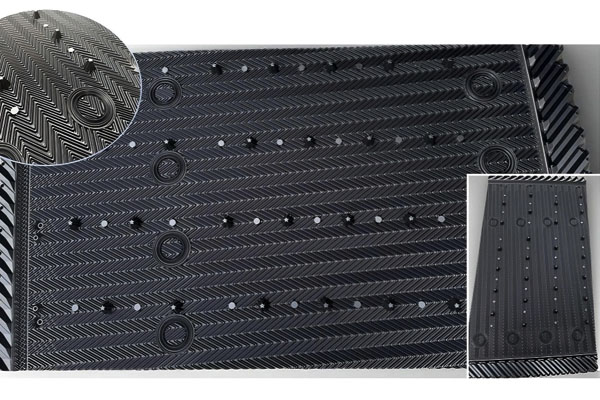
For projects involving wider crossflow sections, products such as 1340mm and 1350mm wide cross-flow cooling tower fill provide dimensional options that can be evaluated against actual site measurements.
However, selecting between these widths should be based on the available installation space rather than assuming that a small dimensional difference will not matter.
Another common mistake is measuring only the removed fill panels.
Old fill may have experienced deformation, compression, or damage during removal. Its dimensions may therefore differ from the original manufactured size.
A more reliable approach is to measure the tower structure itself, including:
Measurements should be taken at several positions rather than relying on a single point. This is particularly important when the supporting structure is no longer perfectly aligned.
A replacement panel can have the correct width and length while still being unsuitable for the existing tower.
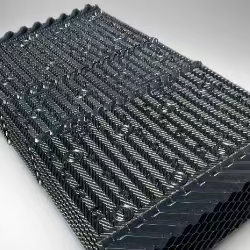
Corrugation pitch, sheet orientation, material thickness, and assembly method all influence how the fill interacts with the tower's water and airflow systems.
For example, changing the internal corrugation arrangement may affect airflow resistance and water distribution. A replacement should therefore be evaluated as part of the existing cooling tower system rather than as an isolated plastic component.
When several fill sizes are required within one project, multi-specification cross-flow cooling tower fill can provide a practical basis for discussing different dimensional requirements.
The objective is not to introduce unnecessary variations. It is to identify where different dimensions are genuinely needed.
For refurbishment projects, the most effective approach is to prepare a simple installation schedule before placing the order.
Each tower section should have its own recorded dimensions, required quantity, connection method, and any special installation restrictions.
Where wider panels are needed, options such as 1470mm width cooling tower fill can be reviewed against the actual supporting structure and handling conditions.
Sharing photographs of the existing fill arrangement can also help the manufacturer identify potential compatibility problems before production begins.
Replacement cooling tower fill should never be selected from dimensions alone. The condition of the existing tower, its supporting structure, and the required fill arrangement must all be considered.
Accurate measurements and early technical confirmation can reduce cutting, installation delays, and unnecessary replacement costs. For industrial cooling tower refurbishment, these details often matter more than small differences in the initial purchase price.
Industry trends and cooling tower fill media insights for global customers.
As industrial facilities continue to improve energy efficiency and equipment reliability, cooling to
Why Replacement Cooling Tower Fill Sometimes Fits the Drawing but Not the TowerOne of the most frust
Connect with our team for cooling tower fill media details, project information, and technical assistance.
Chat on WhatsApp