
As industrial facilities continue to imp

Selecting suitable cooling tower fill me
How Cooling Tower Fill Design Affects En
Large cooling tower fill panels are often selected because they reduce the number of individual pieces required inside a tower. From a purchasing perspective, this appears to be an obvious advantage. Fewer pieces should mean fewer installation operations and potentially lower labor costs.
However, experienced cooling tower contractors know that larger panels are not automatically easier to install.
Panel width affects transportation, unloading, handling, access through tower openings, and positioning inside the fill section. A larger panel may reduce assembly work while creating additional difficulties elsewhere in the installation process.
Before choosing wide cooling tower fill, contractors should examine how the material will reach its final installation position.
A panel may fit perfectly inside the designed fill section but still be difficult to move through the available maintenance opening.
This problem is particularly relevant to older towers where access was originally designed around smaller fill modules.
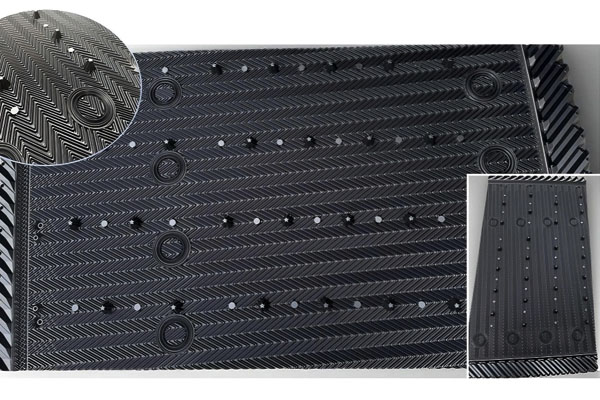
For example, 1830mm width cooling tower fill may be suitable for certain large installation sections, but its dimensions must also be checked against the available handling space.
Contractors should consider the complete movement route, including lifting equipment, maintenance doors, internal walkways, and the space available for rotating panels into position.
Wide fill sheets and assembled modules may require additional care during transportation and installation.
The handling requirements depend on material thickness, corrugation structure, assembly method, and whether the product is supplied as individual sheets or completed modules.
Workers should avoid applying concentrated loads that could deform the corrugations or damage unsupported sections.
It is also important to distinguish between sheet dimensions and assembled module dimensions. A wide sheet does not necessarily mean that the final installed module must be transported as one large piece.
For some projects, supplying sheets for controlled on-site assembly may be more practical than delivering large preassembled blocks.
Large panels become advantageous when the tower has sufficient access space and the supporting structure is designed for the selected dimensions.
In these conditions, fewer individual sections may reduce repetitive positioning and alignment work.
Products such as 1500mm width cooling tower fill can be considered for installations where the specified width matches the tower arrangement.
However, installation efficiency should be evaluated using the complete project rather than the number of panels alone.
A useful comparison includes:
Purchasing teams sometimes assume that the widest available product will provide the greatest installation efficiency.
In reality, a slightly narrower panel may be easier to transport, position, and replace during future maintenance.
For installations with intermediate width requirements, 1520 width cooling tower fill offers another dimensional option for engineering evaluation.
The final choice should consider the tower's structural layout and the practical limitations of the installation site.
Packaging is frequently treated as a shipping detail, but it can influence installation efficiency.
For overseas projects, contractors should confirm whether the fill will be supplied as loose sheets, partially assembled sections, or completed modules.
This decision affects container loading, unloading equipment, temporary storage, and the amount of assembly work required on site.
Providing the manufacturer with information about installation access and handling restrictions can help identify a more suitable delivery arrangement.
Large cooling tower fill panels can reduce installation work, but only when their dimensions match the tower structure and site conditions.
The most practical solution is not necessarily the widest product available. It is the panel arrangement that balances manufacturing dimensions, transportation, handling, installation, and future maintenance requirements.
Evaluating these factors before ordering can help industrial cooling tower contractors avoid delays and control total project costs.
Industry trends and cooling tower fill media insights for global customers.
As industrial facilities continue to improve energy efficiency and equipment reliability, cooling to

Large Cooling Tower Fill Panels: When Fewer Pieces Create More Installation WorkLarge cooling tower
Connect with our team for cooling tower fill media details, project information, and technical assistance.
Chat on WhatsApp