
As industrial facilities continue to imp
Selecting suitable cooling tower fill me
How Cooling Tower Fill Design Affects En
Cooling tower fill purchasing often appears straightforward. The buyer sends a product name, several dimensions, and the required quantity. The supplier provides a quotation, and production begins after the order is confirmed.
Unfortunately, incomplete specifications can create problems long before the material reaches the installation site.
For industrial cooling tower projects, a technically incomplete purchase order may lead to repeated drawing revisions, incorrect material preparation, or unexpected installation difficulties.
Most of these problems can be avoided by confirming a few essential details before production.
A request for 750mm cooling tower fill does not necessarily provide enough information for manufacturing.
The supplier may still need to confirm the required length, sheet thickness, corrugation pitch, and whether the dimensions refer to individual sheets or assembled modules.
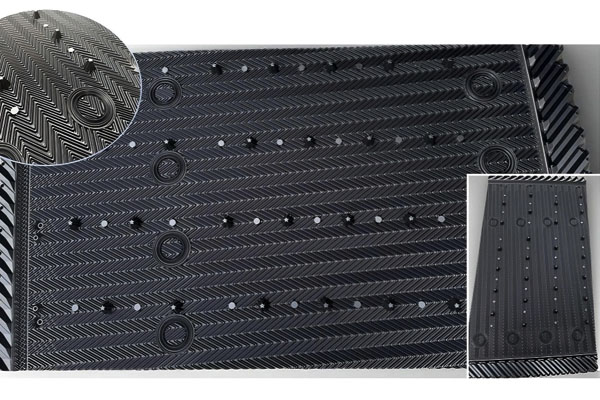
For example, cooling tower fill in 500mm, 625mm, and 750mm widths provides several dimensional options, but the appropriate configuration still depends on the installation requirements.
Providing a complete dimensional drawing is generally more reliable than supplying width alone.
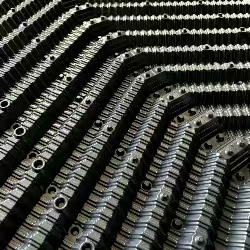
Corrugation geometry is a functional characteristic of structured cooling tower fill.
It affects the internal flow passages and must be compatible with the intended application.
When buyers request replacement material, they should confirm the existing corrugation pitch and orientation whenever possible.
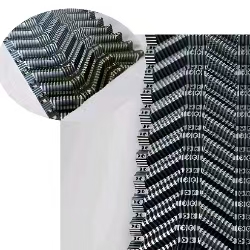
For example, 15mm pitch cooling tower fill for wide crossflow arrangements has a defined pitch requirement that should not be confused with other available structures.
If the original specification is unknown, sending a sample or detailed photographs can help clarify the requirement.
Cooling tower fill may be supplied in different assembly configurations depending on the product and installation design.
Some projects require glued modules, while others use hanging arrangements or alternative supporting methods.
These requirements should be confirmed before production rather than left for the installation contractor to resolve on site.
For products such as 90° cooling tower fill for flexible installation, buyers should verify that the selected configuration matches the tower's structural and connection requirements.
The term flexible installation should not be interpreted as universal compatibility with every cooling tower.
PVC, CPVC, and PP are commonly considered for different cooling tower fill applications, but they should not be treated as interchangeable materials.
Operating temperature, water chemistry, mechanical requirements, and expected service conditions can influence material suitability.
A purchase order that specifies only the material name may overlook important limitations.
For projects involving unusual operating temperatures or chemical exposure, the buyer should provide the relevant conditions and request confirmation of material suitability.
Material selection should follow the actual operating environment rather than relying only on previous purchasing habits.
Another common source of confusion is the unit used to describe the required quantity.
Cooling tower fill may be quoted by individual sheet, assembled module, cubic meter, or another agreed unit.
If the quotation and purchase order use different quantity definitions, the delivered material may not match the buyer's expectations.
Buyers should also confirm whether the material will be shipped as individual sheets or assembled sections.
This affects packaging dimensions, container loading, unloading arrangements, and installation preparation.
Before issuing a final purchase order, the buyer should prepare a technical confirmation sheet containing the required dimensions, material, corrugation structure, connection method, quantity unit, and delivery arrangement.
For replacement projects, the document should also identify the existing tower model or provide photographs and measurements of the installation area.
Where customization is required, confirming these details before manufacturing can reduce repeated communication and avoid unnecessary production changes.
A successful cooling tower fill purchase begins with accurate technical information.
Price and delivery time are important, but they should be compared only after suppliers understand the same specifications and installation requirements.
Clear purchase orders help manufacturers prepare suitable products and allow contractors to plan installation with fewer uncertainties.
For overseas cooling tower projects, this preparation can be particularly valuable because correcting specification mistakes after international shipment is often expensive and time-consuming.
Industry trends and cooling tower fill media insights for global customers.
As industrial facilities continue to improve energy efficiency and equipment reliability, cooling to
Cooling Tower Fill Purchase Orders: Five Missing Details That Cause Costly Production DelaysCooling
Connect with our team for cooling tower fill media details, project information, and technical assistance.
Chat on WhatsApp