
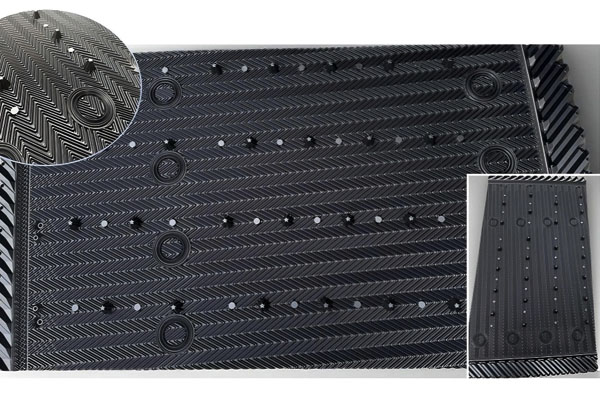
As industrial facilities continue to imp
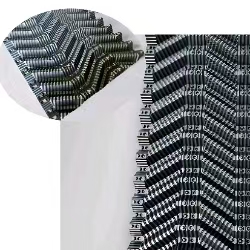
Selecting suitable cooling tower fill me
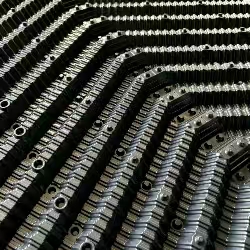
How Cooling Tower Fill Design Affects En
When inspecting an operating cooling tower, many engineers expect all Cooling Tower Fill sections inside the tower to have the same condition.
After all, the fill material is usually installed at the same time, using the same product model and operating with the same circulating water system.
However, actual field experience shows something different.
Different areas of the same cooling tower can experience different levels of scaling, fouling, wetting, airflow and aging.
Understanding why this happens is important because a single damaged fill sample does not always represent the condition of the entire tower.
A cooling tower is not a completely uniform heat transfer space.
Inside the tower, local conditions can change depending on location.
The main factors include:
These differences influence how each section of Cooling Tower Media performs over time.
Water distribution is one of the most important factors affecting fill performance.
Ideally, water should be evenly distributed across the entire fill surface.
In real installations, however, some areas may receive slightly more water while others receive less.
Areas receiving excessive water may experience:
Areas receiving insufficient water may experience:
Both situations can reduce the overall efficiency of the Cooling Fill system.
Airflow is another reason why different areas of the tower may age differently.
The fill does not only depend on water.
The cooling process requires continuous interaction between water and air.
If airflow is uneven, some areas may have:
This effect is especially important in large industrial cooling towers.
In a counterflow tower, air enters from the lower part of the tower and moves upward through the fill.
Water enters from above and flows downward.
Because of this arrangement, different sections of the fill may experience different relationships between air and water.
For systems using Counterflow Film Fill, engineers should consider the complete airflow and water path when evaluating performance.
Crossflow towers have another type of operating pattern.
Air enters horizontally through the fill while water moves downward.
The first area contacted by incoming air may experience different contamination and airflow conditions compared with deeper sections.
For crossflow applications, the physical width of the fill can also influence how individual sections fit into the tower and how the available fill area is used. An 870mm Width Cross-flow Fill is one example of a defined-width configuration that can be evaluated when matching fill dimensions to a particular crossflow tower section.
The relationship between air entry and water distribution should be reviewed during inspection.
During maintenance projects, customers sometimes send one small fill sample for evaluation.
Although this can provide useful information, it may not show the full condition of the tower.
The selected sample location is important.
A piece from the center area may look very different from a piece near the air inlet or tower edge.
For a more accurate evaluation, divide the tower into different inspection zones.
Check for:
Check:
Check:
Comparing different zones provides a much clearer understanding of actual fill performance.
Different fill structures respond differently to local operating conditions.
Modern Film Fill designs use corrugated sheets to create large contact areas between water and air.
However, the performance depends on maintaining proper airflow and water movement through these channels.
For applications where an open structure is preferred, Splash Grid Fill for Cooling Tower Applications provides a different fill approach from conventional film-type structures. Its open configuration can be considered where water passage and resistance to fouling are important design considerations.
A damaged or blocked area can influence local performance even if the surrounding fill remains in good condition.
The choice of fill material also influences long-term performance.
Common materials include PVC and PP, depending on the operating environment and required service life.
Different materials may have different resistance characteristics depending on:
When replacing Cooling Tower Fill, engineers should not only consider total volume.
The internal arrangement of the tower should also be reviewed.
Some sections may require:
For example, a crossflow tower may require a specific fill width and length to make efficient use of an existing fill bay. A 1010mm × 2500mm Cross Flow Fill for Cooling Tower Applications represents a defined dimensional configuration that can be considered when replacement blocks need to match an existing tower layout.
In larger fill sections, wider configurations may also be required. A 1520 Width Cooling Tower Fill can be evaluated where the tower structure calls for a wider fill section rather than assuming that one standard width will fit every area.
This is especially common in older towers that have experienced modifications during years of operation.
Because the fill depends on both air and water conditions, other tower components should also be inspected.
Air entry conditions, water distribution equipment and drift control can all influence how individual fill sections operate.
A problem outside the fill itself can therefore create different operating conditions from one tower area to another.
When evaluating Cooling Tower Fill condition, avoid making decisions based on only one location.
A better approach is:
This method provides a much more accurate picture of the real condition of the tower.
Cooling Tower Fill performance is not always uniform across the entire tower.
Different areas experience different airflow, water distribution and environmental conditions.
For this reason, professional evaluation should focus on understanding the complete system rather than judging the tower from one small sample.
A good Cooling Tower Fill solution is not only about selecting the right material or design.
It is also about understanding how every section of the tower works together during real operation.
Industry trends and cooling tower fill media insights for global customers.
As industrial facilities continue to improve energy efficiency and equipment reliability, cooling to
Winter Operation: Cooling Tower Fill Challenges and Cold-Weather AdaptationsWhy Winter Changes the R
Connect with our team for cooling tower fill media details, project information, and technical assistance.
Chat on WhatsApp