
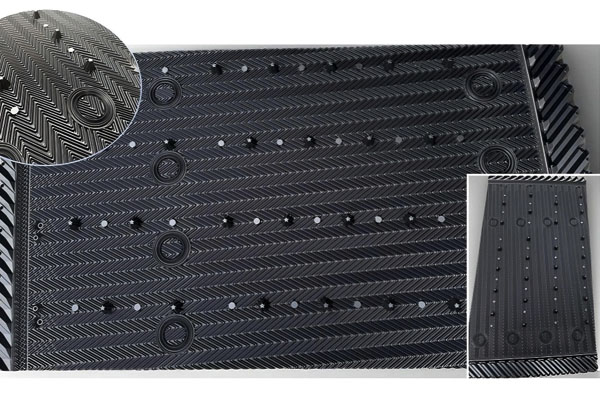
As industrial facilities continue to imp
Selecting suitable cooling tower fill me
How Cooling Tower Fill Design Affects En
Many cooling tower operators believe that if the water looks cleaner after changing a water treatment program, the Cooling Tower Fill should automatically perform better.
However, real operating conditions are often more complicated.
A change in water treatment chemicals can influence how the fill behaves over time. The effect may appear as changes in scaling, fouling, surface wetting, pressure drop or even the service life of the fill material.
The reason is simple: Cooling Tower Fill does not operate separately from the water chemistry system. The two systems work together every day.
The purpose of water treatment is to control problems such as:
At the same time, the fill provides the surface where water and air exchange heat.
Because the fill has a large surface area and many small flow channels, any change in water chemistry can eventually influence the condition of the fill.
When a plant changes water treatment suppliers or chemical formulas, several things may change at the same time:
Even if the new program is technically correct, the existing Cooling Tower Media may react differently during the transition period.
One common misunderstanding is that all scale problems look the same.
In reality, deposits inside Film Fill can vary significantly.
Traditional scaling may create hard deposits that reduce the opening area inside the fill.
These deposits can restrict water movement and reduce effective heat transfer.
Some water treatment changes may reduce hard scale but create different fouling conditions if biological control is not properly balanced.
Soft deposits can also block airflow passages and affect the performance of the fill.
Modern Film Fill depends on maintaining open channels for air and water movement.
The corrugated structure creates a large contact area between the two fluids.
When deposits accumulate, several changes can occur:
The fill may still look acceptable from the outside while internal performance has already changed.
After changing water treatment chemicals, operators sometimes expect quick improvement.
However, existing deposits may remain inside the fill for a long period.
A new chemical program may prevent future deposits but cannot instantly restore the original structure of old Cooling Tower Fill.
This is why inspection after a water treatment change is still important.
Cooling tower fill materials are selected based on operating conditions.
Common materials include PVC and PP cooling tower fill.
Material selection should consider:
A water treatment program suitable for one application may not create the same long-term result in another environment.
Water treatment changes can sometimes modify deposit patterns.
If deposits begin forming unevenly, the water distribution pattern through the fill may also become uneven.
For counterflow applications using 750/930mm Cross-flow/Counter-flow Fill, engineers should pay particular attention to maintaining uniform water distribution and keeping the fill passages open.
In crossflow applications, the fill structure must also work effectively with the tower's horizontal airflow and vertical water movement. A Multi-Specification Cross Flow Cooling Tower Fill can provide different width options for crossflow tower configurations where installation dimensions and water distribution requirements need to be considered together.
For applications where the surface structure is an important part of the design, Cross-flow Cooling Tower Fill (Double-wave Design) offers another configuration to evaluate when reviewing water spreading and air-water contact after changes in operating conditions.
A water treatment change should be followed by a practical inspection plan.
Look for:
Observe whether water still spreads evenly across the fill area.
Compare:
Changes inside the fill can influence airflow resistance.
This is especially important when evaluating older towers after chemical program changes.
Yes, but only when the complete system is managed correctly.
A suitable water treatment program can help reduce:
However, the fill condition should still be monitored because chemical control cannot repair mechanical damage or permanently deformed sheets.
When water conditions change, other tower components should also be reviewed.
For example, poor drift control may increase water loss and chemical consumption.
Inspect:
A cooling tower is a complete system, and chemical changes can influence multiple components.
When performance changes after a water treatment adjustment, do not immediately replace the fill.
First evaluate:
The correct solution may be cleaning, chemical adjustment, partial replacement or complete Cooling Tower Fill replacement.
Cooling Tower Fill performance is closely connected with water chemistry.
A change in water treatment chemicals can improve operating conditions, but it can also change the way deposits form and how the fill performs over time.
The best results come from managing water treatment and Cooling Tower Media as one complete system.
When engineers understand this relationship, they can extend fill service life, maintain cooling efficiency and avoid unnecessary replacement costs.
Industry trends and cooling tower fill media insights for global customers.
As industrial facilities continue to improve energy efficiency and equipment reliability, cooling to
Winter Operation: Cooling Tower Fill Challenges and Cold-Weather AdaptationsWhy Winter Changes the R
Connect with our team for cooling tower fill media details, project information, and technical assistance.
Chat on WhatsApp