
As industrial facilities continue to imp
Selecting suitable cooling tower fill me
How Cooling Tower Fill Design Affects En
Increasing water flow rate is often considered a simple way to improve cooling tower performance.
When a factory expands production capacity, engineers may increase pump capacity or modify the circulation system to send more water through the cooling tower.
However, an unexpected situation can sometimes happen:
The water flow rate increases, but the cooling performance does not improve as expected. In some cases, the outlet water temperature may even become higher.
The reason is that Cooling Tower Fill performance depends on the balance between water loading, airflow and fill design. More water does not always mean better heat transfer.
The main purpose of Cooling Tower Fill is to maximize contact between water and air.
Inside a Film Fill system, water spreads across the corrugated plastic surfaces while air passes through the channels created by the fill structure.
The performance depends on maintaining a suitable balance:
When water flow exceeds the condition that the fill system was designed for, this balance can change.
There are several reasons why increasing water flow may not create the expected improvement.
Film Fill works by creating thin water films on the plastic surface.
When the water volume becomes too high, the water layer may become thicker instead of spreading efficiently.
This can reduce the effective air-water contact area.
The fill may still be fully wet, but the heat transfer process may not become more efficient.
Cooling towers require a proper relationship between air flow and water flow.
If water increases without a corresponding increase in airflow, the air side may become the limiting factor.
The tower then has more water to cool but the same amount of air available for heat removal.
Higher water flow can increase the speed at which water moves through the fill.
This may reduce the time available for heat and mass transfer.
The result is that more water passes through the fill but does not receive enough cooling.
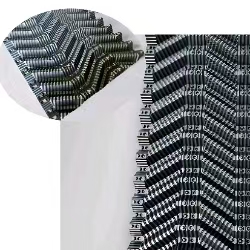
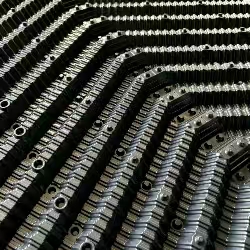
Most modern Film Fill designs use corrugated sheets to create internal channels.
The shape and spacing of these channels determine how water and air interact.
Different Corrugated Fill designs can handle different operating conditions.
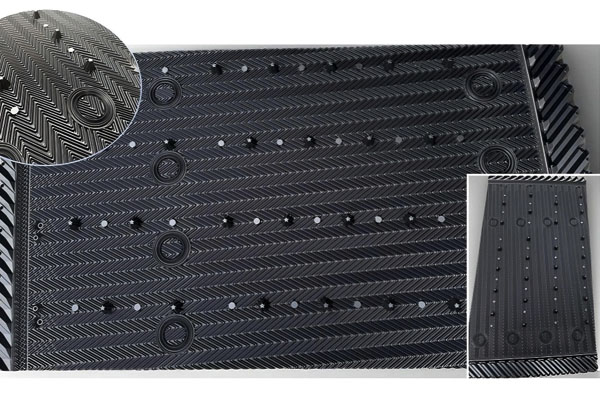
For example, a 1200mm Double-Ripple Cooling Tower Fill uses a double-ripple surface structure to create additional water spreading paths and air-water contact points. This type of structure can be considered when an existing tower requires a different fill configuration after operating conditions change.
Important design factors include:
A fill that performs well under one water loading condition may not provide the same result after a major increase in flow rate.
Many industrial cooling towers were designed based on the original factory production capacity.
Years later, the operating conditions may change:
The existing Cooling Tower Media may still be physically healthy, but the operating conditions may no longer match the original design.
In counterflow towers, water flows downward while air moves upward through the fill.
The balance between downward water loading and upward airflow is critical.
For applications using Counterflow Film Fill, engineers should consider whether the existing fill height and structure are suitable for the increased water volume.
Simply increasing pump capacity may not always produce additional cooling capacity.
Crossflow towers have a different operating arrangement.
Air enters horizontally through the fill while water moves vertically downward.
When increasing water flow in systems using Multi-width Glue/Hang Dual-purpose Cross-flow Fill, water distribution uniformity becomes especially important.
The multi-width configuration also provides installation flexibility for different crossflow tower structures, which can be useful when upgrading or replacing existing fill after changes in circulation requirements.
If some areas receive too much water while others receive too little, the total fill volume may not be used effectively.
Engineers can look for several practical signs:
These symptoms suggest that the entire air-water system should be reviewed.
Not necessarily.
The correct solution depends on the actual operating condition.
Possible solutions may include:
For towers where suspended solids, fouling or restricted flow passages are a concern, an open-structure option such as Splash Grid Fill for Cooling Tower Applications may also be worth evaluating. Its open grid structure is designed to provide stable water passages and can be considered for applications where fouling resistance is more important than maximizing film surface area.
The key is identifying whether the limitation comes from the fill, airflow or water distribution system.
When upgrading a cooling tower, material selection should also be reviewed.
Common options include PVC and PP cooling tower fill, depending on the operating environment and required service life.
The best choice depends on:
A cooling tower is a complete system, not only a collection of fill sheets.
Increasing water flow affects:
For example, increased water carryover or excessive splash may indicate that the tower requires a wider inspection rather than simply adding more circulation water.
Before increasing circulation water volume, engineers should review:
This evaluation helps determine whether the tower has enough capacity for the new operating condition.
Increasing water flow is not always the same as increasing cooling capacity.
Cooling Tower Fill works best when water flow, airflow and fill structure remain properly balanced.
When operating conditions change, engineers should evaluate the complete cooling system instead of simply increasing pump capacity.
The right Cooling Fill solution is not the one that handles the most water.
It is the one that creates the best interaction between water and air under the real operating conditions of the tower.
Industry trends and cooling tower fill media insights for global customers.
As industrial facilities continue to improve energy efficiency and equipment reliability, cooling to
Winter Operation: Cooling Tower Fill Challenges and Cold-Weather AdaptationsWhy Winter Changes the R
Connect with our team for cooling tower fill media details, project information, and technical assistance.
Chat on WhatsApp