
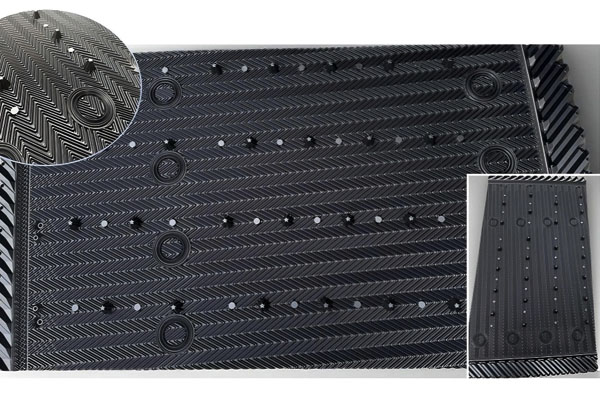
As industrial facilities continue to imp
Selecting suitable cooling tower fill me
How Cooling Tower Fill Design Affects En
One thing that often surprises cooling tower operators is that the same Cooling Tower Fill can produce different operating results when it is installed in two different towers.
The product may have the same material, same sheet structure and even the same nominal dimensions. Yet the actual cooling performance, air resistance and water distribution can still be different.
This does not necessarily mean that one batch of fill is better than another.
In many cases, the difference comes from something much simpler: the way the fill is installed and operated inside the tower.
Fill depth, air velocity, water loading, fan condition and the overall tower arrangement all influence how Cooling Tower Media behaves once it becomes part of a working cooling system.
This is an area where a product specification sheet alone cannot tell the whole story.
It is easy to think of Cooling Tower Fill as an independent product.
In reality, it is one part of a larger air-water heat transfer system.
The fill creates the surface and flow paths that allow water to spread while air passes through the structure.
The final result depends on how these conditions interact.
A simplified way to think about the system is:
Changing the fill depth can therefore change more than simply the amount of Cooling Tower Media inside the tower.
Fill depth refers to the effective thickness or height of the fill section through which the air and water travel.
The exact definition can vary according to the tower configuration and fill arrangement, but the basic engineering principle remains the same.
A deeper fill section gives the air and water more structured surface through which to interact.
However, deeper does not automatically mean better.
This is one of the most important points to understand.
Customers sometimes assume that adding more Film Fill will automatically increase cooling performance.
It sounds logical.
More fill means more surface area, so why would more not always be better?
The answer is that the cooling tower also has an air-moving system.
As the amount of structured fill increases, the resistance experienced by the air can also change.
If the fan system cannot provide the required airflow under the new resistance conditions, the expected benefit of additional fill may not be achieved.
In some cases, adding more fill can therefore produce a result that is much less impressive than expected.
Air needs to travel through the fill structure.
Every structured passage creates some level of resistance to that airflow.
When the effective fill depth increases, the air generally has a longer path through the structured media.
This means the fan system has to work against the characteristics of the complete air path rather than the fill alone.
This is why experienced cooling tower engineers do not normally look at fill depth without considering the fan and airflow conditions.
A fill replacement project can change the airflow characteristics of a tower if the new fill has significantly different structural characteristics or if the installed depth changes.
The tower fan was selected for a particular operating system.
It is therefore important to consider the complete system rather than assuming that the fan will automatically deliver the same airflow after every fill modification.
In a counterflow cooling tower, water moves downward while air travels upward through the fill.
Counterflow Film Fill is commonly used for this configuration.
Because air and water move in opposite directions, the fill section becomes an important part of the overall resistance and heat transfer path.
If the fill arrangement is changed without considering the rest of the tower, the actual operating condition may differ from what the customer expected.
This is one reason we recommend reviewing the existing tower conditions before making significant changes to the fill arrangement.
Crossflow towers operate differently.
Air enters through the side of the tower and passes horizontally through the fill while water moves downward.
A Multi-width Glue/Hang Dual-purpose Cross-flow Fill can be considered when evaluating a crossflow tower where fill width, installation method and existing tower geometry all need to be matched together.
Because the airflow direction and tower geometry are different, the effect of fill depth should also be considered according to the actual crossflow arrangement.
A fill specification that works well in one tower should not automatically be copied into another tower simply because both systems are described as crossflow.
Airflow is only one side of the equation.
The amount of water entering the fill also influences how the Cooling Tower Fill operates.
If the water loading changes significantly, the wetting condition of the fill can change as well.
A fill structure that performs well under one water loading condition may behave differently when the flow rate is substantially higher or lower.
This is one reason why cooling tower performance should be evaluated under actual operating conditions rather than by looking at the fill product in isolation.
Even if the fill depth and airflow are correct, poor water distribution can prevent the available fill surface from being used effectively.
Some areas may receive excessive water while other areas receive too little.
The result is that the theoretical fill volume and the effectively used fill volume are not necessarily the same thing.
This is an important distinction when evaluating Cooling Fill performance.
A tower may physically contain a large amount of fill, but that does not mean every part of it is contributing equally to heat transfer.
Consider two cooling towers using the same Film Fill.
Tower A has:
Tower B uses the same fill product but has:
The two towers may obviously produce different results.
The difference should not automatically be blamed on the Cooling Tower Fill.
The operating system around the fill is part of the performance equation.
A fill section that is too shallow may provide less available contact area than the tower requires for the desired operating condition.
The actual result depends on the tower design, water loading, airflow and fill characteristics.
However, reducing the effective fill volume without checking the thermal requirement can reduce the available opportunity for air-water contact.
This is why simply reducing fill height to solve an installation problem should not be treated as a harmless dimensional change.
The opposite problem is also possible.
Increasing the fill depth may increase the available heat transfer surface, but it can also increase airflow resistance.
If the tower fan cannot maintain the required air movement, the theoretical benefit of additional Cooling Tower Media may not translate into proportional real-world cooling improvement.
Fill structure also matters when evaluating whether additional depth is appropriate. For example, a 1200mm Double-Ripple Cooling Tower Fill should be evaluated according to its actual installation depth, airflow requirement, water loading and tower geometry rather than assuming that a deeper installation will automatically provide better cooling.
In other words:
More fill is not the same thing as more useful cooling.
Industry trends and cooling tower fill media insights for global customers.
As industrial facilities continue to improve energy efficiency and equipment reliability, cooling to
Winter Operation: Cooling Tower Fill Challenges and Cold-Weather AdaptationsWhy Winter Changes the R
Connect with our team for cooling tower fill media details, project information, and technical assistance.
Chat on WhatsApp