
As industrial facilities continue to imp
Selecting suitable cooling tower fill me
How Cooling Tower Fill Design Affects En
If you've managed cooling towers for several years, you've probably noticed something interesting. Two facilities may install new Cooling Tower Fill around the same time, yet one system continues operating efficiently for more than 15 years while the other requires replacement after only five.
Many people assume this difference comes down to product quality alone. In reality, the service life of Cooling Tower Fill depends on a combination of operating conditions, water quality, maintenance practices, material selection, and system design.
Choosing the right Cooling Tower Media is important, but understanding what affects its lifespan is even more valuable. A well-maintained fill pack can provide reliable cooling for many years, while the wrong operating conditions can shorten its life significantly.
Cooling Tower Fill is continuously exposed to warm water, moving air, sunlight, chemicals, and mechanical stress. Over time, these factors gradually affect both the structure and performance of the fill.
Instead of asking "How long will this fill last?", experienced engineers usually ask a different question:
"Under these operating conditions, how long can this fill continue performing efficiently?"
Systems operating with properly treated circulating water usually experience slower scaling, less biological growth, and lower maintenance costs.
Film Fill performs especially well under these conditions because its narrow flow channels remain open and provide excellent heat transfer efficiency.
Industrial process water often contains suspended solids, oil, minerals, or biological contaminants. These materials can gradually accumulate inside the fill structure, restricting airflow passages and reducing cooling efficiency.
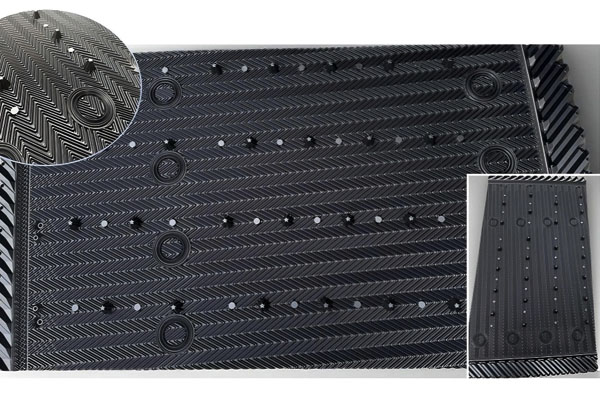
When a cooling tower operates with water that has a higher risk of fouling, the fill structure becomes an especially important consideration. A design such as Cross-flow Cooling Tower Fill (Double-wave Design) can be evaluated for crossflow applications where the fill configuration needs to be matched with the water condition and maintenance requirements.
The important point is that no fill design can compensate for severely uncontrolled water chemistry. Proper water treatment remains one of the most effective ways to extend Cooling Tower Fill service life.
PVC Cooling Tower Fill is widely used in commercial HVAC systems and many industrial cooling towers because it combines high cooling efficiency with competitive cost.
When operated within its recommended temperature range and supported by good water treatment, PVC can provide many years of reliable performance.
For applications involving higher temperatures or aggressive chemicals, PP Cooling Tower Fill is often preferred because polypropylene offers improved chemical resistance and greater thermal stability.
Selecting the correct material for the operating environment is one of the simplest ways to extend service life. The material should always be evaluated together with operating temperature, water chemistry, and the required cooling performance.
Many maintenance teams focus on water quality but forget that airflow also affects the condition of the fill.
Restricted airflow can increase moisture retention inside the fill pack, encourage biological growth, and reduce heat transfer efficiency.
Blocked air passages, poor fan performance, or damaged tower components should therefore be investigated before deciding that the Cooling Tower Fill itself has reached the end of its service life.
In many cases, restoring proper airflow and water distribution can recover part of the lost cooling performance without immediately replacing the entire fill pack.
Counterflow towers depend on stable vertical airflow through the fill pack. Air moves upward while water travels downward, creating the counter-current contact required for effective heat transfer.
For replacement projects, the fill dimensions must match the existing tower configuration rather than being selected by service life or thickness alone. A product such as 750/930mm Cross-flow/Counter-flow Fill can be considered when the counterflow tower requires a compatible fill width and configuration.
The correct fit is important because an unsuitable fill arrangement can affect airflow distribution, water contact, installation stability, and ultimately the service life of the entire fill pack.
Crossflow systems rely on horizontal airflow through the fill section, while water is distributed vertically over the fill surface.
Because the airflow path and water distribution arrangement differ from counterflow towers, crossflow replacement fill should be selected according to the tower's existing dimensions and internal configuration.
For wider crossflow installations, 1500mm Width Cooling Tower Fill can be considered where the available tower space and existing fill arrangement require a wider section.
This is why simply asking for "longer-lasting fill" is not enough when replacing an existing pack. The fill width, structure, material, and tower type all need to be compatible with the actual application.
No. Service life depends far more on operating conditions than on a fixed number of years. Water chemistry, temperature, airflow, maintenance, installation quality, and fill selection can all influence how long the fill remains effective.
Not necessarily. Many systems operate much longer when water treatment and routine maintenance are properly managed. If a fill pack is failing unusually early, the operating conditions should be investigated before simply accepting frequent replacement as normal.
One pattern we've observed across many retrofit projects is that fill rarely reaches the end of its service life because of age alone. In most cases, early replacement is caused by preventable issues such as poor water treatment, blocked spray nozzles, restricted airflow, or incorrect material selection.
Another common problem is treating replacement as a simple dimension-for-dimension purchase. A fill pack can have the correct length and width but still perform poorly if its structure, material, airflow characteristics, or application do not match the cooling tower.
Addressing these factors early often extends the useful life of Cooling Tower Fill far beyond initial expectations.
There is no universal answer. Depending on operating conditions, service life may range from several years to well over a decade. Water quality, operating temperature, maintenance, material selection, and installation conditions all influence actual service life.
If fouling is moderate and the structure remains intact, cleaning may restore part of the original performance. Severely aged, brittle, deformed, or structurally damaged fill is usually more economical to replace.
Not in every application. PP generally performs better under higher temperatures and aggressive chemical conditions, while PVC remains an excellent choice for standard cooling tower systems with controlled water quality. The better material is the one that matches the actual operating environment.
If the remaining fill is in good condition and matches the replacement material and configuration, partial replacement may be possible. However, complete replacement often provides more consistent long-term performance and avoids differences between old and new fill sections.
If you're evaluating Cooling Tower Fill replacement, the most useful information to review is usually related to fill selection, tower configuration, water conditions, and installation requirements.
The lifespan of Cooling Tower Fill is influenced by much more than the manufacturing date. Water quality, operating temperature, airflow, material selection, maintenance practices, installation quality, and proper fill configuration all contribute to long-term performance.
Choosing a replacement fill should therefore start with the actual cooling tower rather than with a simple question of how many years the product is expected to last. Counterflow and crossflow towers have different airflow and water distribution characteristics, and the fill dimensions must be matched accordingly.
By selecting the right Cooling Tower Media for the operating environment and maintaining the complete cooling system, operators can significantly extend service life while reducing downtime, unexpected replacement costs, and loss of cooling performance.
Industry trends and cooling tower fill media insights for global customers.
As industrial facilities continue to improve energy efficiency and equipment reliability, cooling to
Winter Operation: Cooling Tower Fill Challenges and Cold-Weather AdaptationsWhy Winter Changes the R
Connect with our team for cooling tower fill media details, project information, and technical assistance.
Chat on WhatsApp