
As industrial facilities continue to imp
Selecting suitable cooling tower fill me
How Cooling Tower Fill Design Affects En
When selecting replacement Cooling Tower Fill, many buyers naturally believe that thicker fill must provide better cooling performance. It seems logical: more material means more surface area, more contact time, and therefore better heat transfer.
However, cooling tower engineering is not that simple.
A thicker Cooling Tower Fill does not automatically mean higher efficiency. In many applications, increasing fill depth without considering airflow resistance, fan capacity, water distribution, and operating conditions can actually reduce overall cooling performance.
The best Cooling Tower Media is not always the thickest option. It is the design that creates the right balance between heat transfer and system resistance.
Fill thickness usually refers to the total depth of the fill pack installed inside the cooling tower.
A deeper fill section generally provides:
However, deeper fill also creates more resistance to airflow.
This is why engineers must consider both sides of the equation:
Every Cooling Tower Fill creates a certain amount of airflow resistance. As air passes through the fill channels, it loses pressure.
If the resistance becomes too high, the fan may not be able to provide enough airflow through the entire fill pack.
The result can be:
This is one reason why experienced engineers do not simply choose the deepest fill available. The fill depth must work together with the existing fan capacity and airflow conditions.
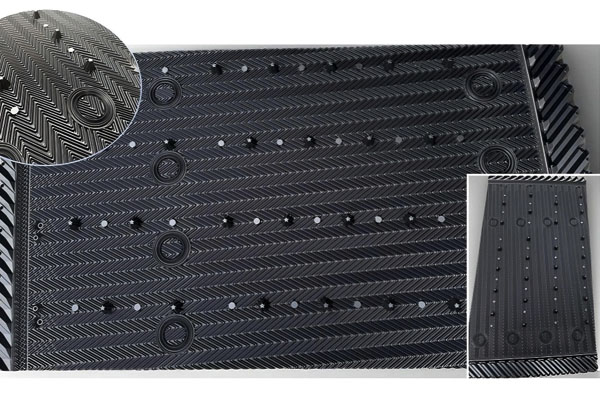
Film Fill has become one of the most common Cooling Tower Media designs because it provides excellent heat transfer efficiency.
The corrugated sheets create a large surface area where water forms a thin film while air passes through the channels.
However, the design must maintain a balance between:
A well-designed Film Fill Cooling Tower system does not depend only on thickness. The geometry of the fill is equally important because channel size, ripple pattern, and overall arrangement all affect the way air and water move through the fill pack.
Many buyers compare Cooling Tower Fill products by surface area numbers alone.
While surface area is important, it is only one part of thermal performance.
A fill with extremely high surface area may create smaller airflow channels, increasing the risk of:
The best design provides enough surface area while allowing air and water to move efficiently through the tower. For replacement projects, this balance is often more important than simply increasing the total fill depth.
Counterflow towers require air and water to move in opposite directions. Air travels upward through the fill while water flows downward, so the fill configuration must support stable vertical airflow and effective water distribution.
For retrofit applications where the available installation space or existing tower configuration requires a specific width arrangement, 305/610mm Dual-width Counter-flow Fill can be used as a counterflow fill option while allowing the replacement design to match the existing tower arrangement more closely.
Crossflow towers introduce air horizontally through the fill section. Because the airflow direction and water distribution arrangement differ from counterflow towers, the required fill width and structure must also be selected according to the specific crossflow tower design.
For crossflow replacement projects, an option such as 870mm Width Cross-flow Fill can be considered when the existing tower requires a compatible 870 mm fill width.
Where a wider fill section is required, 1520 Width Cooling Tower Fill provides another crossflow configuration for projects where the available tower space and fill arrangement call for a wider section.
The key point is that neither counterflow nor crossflow towers should be upgraded simply by adding more fill depth. The replacement fill should first match the tower type, available space, airflow conditions, water distribution system, and required cooling performance.
There are situations where increasing fill depth can improve performance.
In these cases, a deeper fill pack can provide additional heat transfer capability. However, the additional depth should be confirmed against the tower's actual airflow and structural conditions before ordering replacement Cooling Tower Fill.
If the existing fan cannot overcome the additional airflow resistance, increasing fill depth may reduce rather than improve cooling performance.
Deeper and denser fill structures may be more sensitive to scaling and fouling.
For systems with dirty water, the fill structure should be evaluated carefully rather than selecting a denser design simply because it offers a larger nominal heat transfer area.
More fill area does not help if water does not reach the fill evenly. Poor nozzle distribution can leave parts of the fill under-wetted while overloading other areas, reducing the actual cooling performance of the entire pack.
PVC Cooling Tower Fill is suitable for many standard cooling applications where temperature and water chemistry are controlled. For these systems, selecting the correct geometry and dimensions is just as important as choosing the material itself.
PP Cooling Tower Fill is often preferred for higher temperature environments or applications requiring improved chemical resistance. The material should be selected according to the actual operating conditions rather than simply assuming that a more temperature-resistant material will always provide better cooling.
False. Cooling performance depends on the complete balance between heat transfer area and airflow capacity.
Not always. Excessive surface area can increase resistance and reduce actual operating efficiency if the available airflow cannot pass through the fill effectively.
Before choosing a new Cooling Tower Fill design, suppliers should understand:
These details allow the replacement fill to be matched to the actual tower rather than selected only by thickness or surface area.
One common mistake we see during retrofit projects is increasing fill depth without checking whether the existing fan system can support the additional resistance. In some cases, the tower receives less effective airflow after the upgrade, and the expected cooling improvement never appears.
This is why we recommend treating fill replacement as an engineering matching exercise rather than simply replacing an old fill pack with a thicker one. The correct width, depth, structure, and material should all be considered together with the tower's existing operating conditions.
No. The correct fill depth depends on the cooling tower design, airflow capacity, and operating requirements.
Possibly, but airflow, fan capacity, and structural support should be evaluated first. Increasing depth without checking pressure drop can produce the opposite of the expected result.
Film Fill generally requires better water quality because of its smaller channels, while Splash Fill is often more tolerant of suspended solids. The appropriate choice depends on the water condition and the cooling tower's operating requirements.
Check the cooling tower type, existing fill dimensions, fill depth, required cooling capacity, fan conditions, water quality, and available installation space. Providing these details to the supplier can help ensure that the replacement Cooling Tower Media is properly matched to the tower.
Cooling Tower Fill performance is not determined by thickness alone. A successful cooling tower design requires the correct balance between heat transfer surface, airflow resistance, water distribution, fill configuration, and operating conditions.
Instead of choosing the thickest fill available, engineers should select the Cooling Tower Media that best matches the actual cooling system. The right design will provide stable performance, lower operating costs, and a longer service life.
For replacement projects, confirming the cooling tower type and existing fill dimensions before selecting a product is one of the simplest ways to avoid an expensive mismatch and ensure that the new fill performs as intended.
Industry trends and cooling tower fill media insights for global customers.
As industrial facilities continue to improve energy efficiency and equipment reliability, cooling to
Winter Operation: Cooling Tower Fill Challenges and Cold-Weather AdaptationsWhy Winter Changes the R
Connect with our team for cooling tower fill media details, project information, and technical assistance.
Chat on WhatsApp