
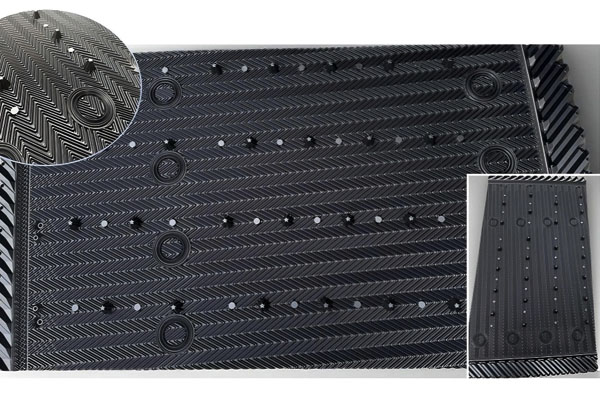
As industrial facilities continue to imp
Selecting suitable cooling tower fill me
How Cooling Tower Fill Design Affects En
Cleaning Cooling Tower Fill is one of the most common maintenance tasks in industrial cooling systems. As scale, biological growth, and airborne debris gradually accumulate inside the fill pack, cooling efficiency often begins to decline.
When this happens, many maintenance teams ask the same question:
Can a pressure washer safely clean Cooling Tower Media?
The answer is yes—but only when it is done correctly. Using excessive water pressure or the wrong cleaning method can permanently damage the fill, reducing its thermal performance and shortening its service life.
Before using a pressure washer, it is important to understand how different Cooling Tower Fill designs respond to cleaning and when replacement may be a better option than cleaning.
The primary function of Cooling Tower Fill is to maximize the contact area between air and water. Over time, deposits inside the fill channels reduce airflow and prevent water from spreading evenly across the surface.
Common contaminants include:
Even when the outside of the Cooling Tower Media appears clean, internal fouling may already be reducing heat transfer efficiency.
Yes, but only under controlled conditions.
High-pressure cleaning can remove loose deposits from Cooling Tower Fill, but excessive pressure may bend thin plastic sheets, damage corrugated channels, or weaken welded joints.
For this reason, most maintenance teams use moderate water pressure combined with suitable cleaning chemicals when necessary.
Film Fill Cooling Tower designs use closely spaced corrugated sheets to create a large heat transfer surface.
These narrow channels deliver excellent cooling performance, but they can also be damaged if water pressure is too high or the spray nozzle is held too close.
Instead of concentrating on removing every stain, the goal should be restoring airflow and water distribution without damaging the fill geometry.
Applications using poor-quality water often experience frequent fouling. In these conditions, a fill design with a more open and accessible structure can make inspection and cleaning easier. For example, 1200mm Double-Ripple Cooling Tower Fill can be considered when selecting a replacement fill for applications where maintenance and fouling control are important considerations.
The most suitable fill should always be selected according to the cooling tower design, water quality, airflow requirements, and expected operating conditions rather than cleaning convenience alone.
Use enough pressure to remove loose debris without deforming the fill sheets.
Whenever possible, direct the water along the corrugation channels instead of spraying across them. This reduces the risk of damaging the fill structure.
Cleaning provides an excellent opportunity to inspect for:
Cleaning cannot repair material aging or structural damage.
Replacement should be considered if the Cooling Tower Fill shows:
PVC Cooling Tower Fill is widely used because it offers an excellent balance of cooling efficiency, durability, and cost. Proper cleaning helps maintain its performance over many years.
PP Cooling Tower Fill is commonly selected for higher-temperature or chemically aggressive environments where additional material resistance is required.
Counterflow towers require careful cleaning because water and airflow travel in opposite directions through the fill section. The fill must maintain its designed passages so that air can move upward while water flows downward across the heat transfer surfaces.
For counterflow applications, the correct fill dimensions, pitch, material, and installation configuration should be confirmed before selecting a replacement product.
Crossflow towers introduce air horizontally through the fill section, so cleaning and replacement requirements differ from those of counterflow towers. The fill must maintain open airflow passages while allowing water to distribute evenly through the fill pack.
For retrofit projects, products such as Multi-width Glue/Hang Dual-purpose Cross-flow Fill can provide a flexible option when different installation or width requirements need to be accommodated.
Another option for crossflow applications is 16.5 Multi-width Cross-flow Fill, which is designed for crossflow cooling tower configurations requiring compatible multi-width fill sections.
Cleaning the fill alone will not restore full cooling performance if other tower components are neglected.
During maintenance, engineers should also inspect:
Not always. Excessive pressure may permanently damage the fill and reduce cooling efficiency.
Visual appearance is only one indicator. Airflow, water distribution, and thermal performance should also be evaluated.
One issue we frequently observe during retrofit projects is that damaged fill is often blamed on poor product quality when the actual cause is aggressive cleaning. High-pressure washing at close range can permanently deform Film Fill channels, reducing airflow long before any visible cracks appear. In many cases, a gentler cleaning method combined with proper water treatment delivers better long-term results.
The cleaning interval depends on water quality, operating conditions, and maintenance practices. Towers using hard or contaminated water generally require more frequent inspections.
If fouling is the main issue, cleaning can significantly improve performance. If the fill has aged or become structurally damaged, replacement may still be necessary.
Not always. The cleaning method should match the type of deposit and the fill material. Always verify that any cleaning chemical is compatible with the fill material and the overall cooling system.
Pressure washing can be an effective way to maintain Cooling Tower Fill when performed correctly, but more pressure does not always mean better cleaning. The goal is to remove deposits while protecting the fill structure. Combining proper cleaning techniques with routine inspection, water treatment, and preventive maintenance helps extend the service life of Cooling Tower Media and maintain stable cooling performance for years to come.
Industry trends and cooling tower fill media insights for global customers.
As industrial facilities continue to improve energy efficiency and equipment reliability, cooling to
Winter Operation: Cooling Tower Fill Challenges and Cold-Weather AdaptationsWhy Winter Changes the R
Connect with our team for cooling tower fill media details, project information, and technical assistance.
Chat on WhatsApp