
As industrial facilities continue to imp
Selecting suitable cooling tower fill me
How Cooling Tower Fill Design Affects En
When an old cooling tower is opened for inspection, one of the first things engineers often notice is that the Cooling Tower Fill does not look quite the same as it did when it was installed.
Some sections may be sagging.
Some blocks may have shifted.
Individual sheets may have become distorted.
In more serious cases, entire sections of fill can partially collapse.
At first glance, this can look like a simple aging problem.
But fill deformation usually has a reason.
Temperature, material selection, support design, water loading, installation, chemical exposure and long-term fouling can all contribute to changes in the physical shape of cooling tower media.
Understanding the cause is important because simply replacing the damaged fill with a similar product may not prevent the same problem from happening again.
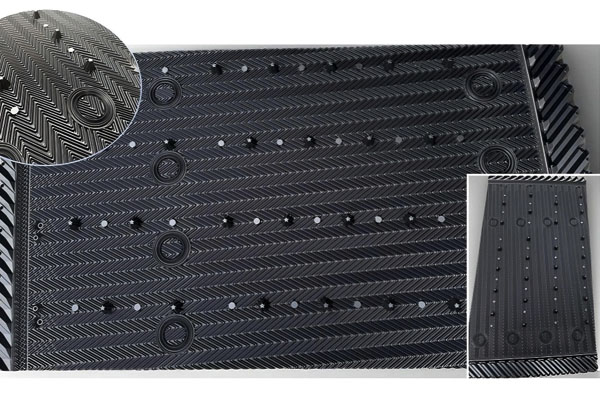
Film Fill is designed around a specific internal geometry.
The corrugated sheets create passages for water and air while providing a large contact area.
If the sheets remain in their intended position, the tower can operate according to the design assumptions.
Once the geometry changes, several things can happen.
So a deformed fill is not simply an appearance issue.
It can become a performance issue.
Plastic materials behave differently at different temperatures.
As operating temperature increases, the mechanical properties of the material can change.
This is one reason why the maximum water temperature should always be considered when selecting Cooling Tower Fill.
The important point is that the maximum temperature may be more important than the average temperature.
A tower might normally operate with hot-water temperatures within a comfortable range.
But during process changes, startup, abnormal operating conditions or equipment failures, the water temperature can temporarily become much higher.
Repeated exposure to conditions outside the intended operating range can contribute to long-term deformation.
This is why engineers should provide both normal and maximum operating temperatures when selecting replacement Cooling Tower Media.
Another common cause is mechanical support.
Cooling tower fill is installed inside a structure that needs to support the weight of the fill and the water carried by it.
If support beams are damaged, incorrectly spaced, badly aligned or deteriorated, the fill can gradually deform under load.
This can happen even when the plastic material itself is suitable.
In an old tower, the fill may be replaced several times while the support structure remains original.
That can create a hidden problem.
The new fill may be lighter, heavier, deeper or arranged differently from the previous system.
If the support system was designed around the original fill configuration, changing the fill without checking the supports can create installation and service problems.
Cooling Tower Fill blocks need to be installed in the intended orientation.
They should be properly supported and positioned so that the internal channels remain stable.
If blocks are forced into an opening that is too small, unsupported sections can be created.
If blocks are installed with excessive gaps, movement may occur.
If the fill is compressed during installation, the original geometry may already be compromised before the tower starts operating.
This is a useful practical point.
Film Fill may look lightweight and flexible, but it is still an engineered heat transfer structure.
It should not be treated like packing material that can simply be squeezed into any available space.
Correct dimensions and proper support are important, particularly when selecting replacement products for existing tower structures.
For crossflow applications where the fill geometry and installation arrangement must match the existing tower, a product such as Cross-flow Cooling Tower Fill(Double-wave Design) can be evaluated according to the actual tower dimensions and installation requirements.
Water itself adds weight.
During operation, the fill is continuously exposed to flowing water.
The actual load depends on water flow, fill geometry and how the water is distributed.
If the tower is operated significantly above the original design water loading, the mechanical environment inside the fill can change.
This is another reason why a cooling tower upgrade should not be considered only as a fill replacement.
If the customer wants to increase cooling capacity by increasing water flow, the existing fill and support system should be evaluated as part of the upgrade.
Fouling can create a second mechanical problem.
Scale, sludge and biological deposits do not simply block the channels.
They can also add weight to the fill structure.
Over a long operating period, deposits can become substantial, especially when water treatment is poor.
This additional weight can contribute to deformation of already weakened sections.
Cooling tower water is not always chemically simple.
Water treatment programs can involve different chemicals, and industrial systems may introduce process contaminants.
The compatibility of the selected plastic with the actual operating environment should therefore be checked before ordering replacement fill.
This is particularly important when the cooling tower has recently changed its water treatment program.
In a counterflow tower, fill deformation can affect the vertical airflow path.
A collapsed section may create a local restriction.
At the same time, water may find a different path through the damaged area.
For towers where the existing installation requires different fill widths or configurations, a product such as 750/930mm Cross-flow/Counter-flow Fill may be considered when confirming replacement dimensions and tower compatibility.
The important point is not the product name alone. The replacement fill still needs to match the tower's airflow direction, support arrangement, available space and operating requirements.
Crossflow systems have their own installation geometry.
Because air moves horizontally through the fill, deformation can affect the air path across the fill depth.
When installing crossflow Cooling Tower Fill, make sure the blocks are properly supported and arranged according to the intended airflow and waterflow direction.
For existing towers where replacement width is an important consideration, an 870mm Width Cross-flow Fill can be evaluated when the existing fill dimensions and support arrangement correspond to that configuration.
Not every visual change means the fill needs immediate replacement.
The question is whether the change affects structural integrity or operating performance.
Small surface deposits or slight visual changes may be manageable depending on the application.
Partial channel blockage, local deformation or small damaged sections should be documented and monitored.
Collapsed blocks, widespread deformation, severe cracking, unstable sections or major channel obstruction generally require much more serious attention.
Film Fill depends on predictable passages.
When sheets bend inward, the available air passage can become smaller.
When sheets move apart, water distribution may change.
When entire blocks collapse, the airflow may find a path around the damaged area instead of moving evenly through the intended fill volume.
This creates a non-uniform operating condition.
Some areas may receive too much air while others receive too little.
Water does not necessarily follow the same path after the fill geometry changes.
A properly designed corrugated structure encourages water to spread and travel along the intended surfaces.
If the sheets deform, water may concentrate into local channels.
This can create a phenomenon sometimes described in the field as channeling.
Instead of using the entire available fill surface, water may travel through a smaller number of preferred paths.
The result can be reduced effective heat transfer.
PVC remains widely used for many conventional cooling tower applications.
When selecting PVC cooling tower fill, confirm that the operating temperature and chemical environment are suitable for the selected product.
Do not assume that every PVC fill has the same mechanical performance. Product design, sheet thickness and manufacturing quality also matter.
PP provides a different set of material characteristics and may be considered for applications where its operating characteristics provide an advantage.
For PP Cooling Tower Fill, the same rule applies: evaluate the actual application rather than selecting material based only on a general reputation.
A scheduled shutdown is an excellent opportunity to inspect fill deformation.
Check whether the fill blocks remain level and properly positioned.
Look for sections that are leaning, compressed or separating.
Where access is safe, inspect the channels for collapse, blockage or heavy deposits.
Inspect support beams and brackets for corrosion, movement or deformation.
When deformation is found, replacement should not begin with a simple measurement of the damaged block alone.
The engineer should also check the available installation space, support spacing, fill orientation and the overall arrangement of the tower.
This is particularly important for older cooling towers because the existing fill may have been modified during previous maintenance projects.
A larger or differently configured replacement fill may require changes to the installation arrangement rather than simply being inserted into the existing space.
For this reason, products such as 1200mm Double-Ripple Cooling Tower Fill should be considered only after confirming the required width, fill arrangement and compatibility with the existing tower.
Replacement should be considered when deformation is widespread enough to affect airflow, water distribution, structural stability or cooling performance.
If only a small isolated section is damaged, partial replacement may sometimes be possible.
However, this depends on the tower design, support arrangement and availability of matching fill.
When a replacement project involves an existing tower with specific dimensions, the supplier should evaluate the required fill width and configuration rather than recommending a standard product based only on appearance.
Cooling Tower Fill does not normally deform for just one reason.
Temperature, support, water loading, fouling, chemical exposure and installation can all contribute.
That is why the right response is not simply to replace the material and move on.
Find out why the original fill deformed.
If the underlying cause remains, the new Cooling Tower Media may eventually develop the same problem.
A good replacement project therefore includes three things: the right material, the right geometry and the right installation conditions.
That combination is far more important to long-term cooling tower performance than simply choosing a new fill block that looks similar to the old one.
Industry trends and cooling tower fill media insights for global customers.
As industrial facilities continue to improve energy efficiency and equipment reliability, cooling to
Winter Operation: Cooling Tower Fill Challenges and Cold-Weather AdaptationsWhy Winter Changes the R
Connect with our team for cooling tower fill media details, project information, and technical assistance.
Chat on WhatsApp