
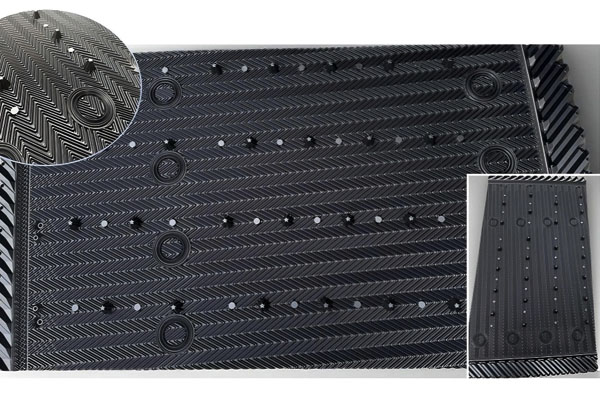
As industrial facilities continue to imp
Selecting suitable cooling tower fill me
How Cooling Tower Fill Design Affects En
One of the most expensive mistakes in cooling tower maintenance is replacing components simply because the tower is old.
The opposite mistake can be just as expensive: leaving old Cooling Tower Fill in service because it still looks acceptable from a distance.
The practical answer is inspection.
A proper inspection can help determine whether the fill should be cleaned, partially repaired, monitored or completely replaced.
This is particularly useful during an annual shutdown or planned maintenance period, when the cooling tower is already out of service.
Cooling Tower Fill works inside the tower, so operators cannot always see what is happening during normal operation.
From outside, the tower may look completely normal.
Inside, however, the fill may have developed:
A shutdown inspection provides an opportunity to identify these problems before they become an emergency.
A cooling tower is not simply an empty industrial structure.
There may be slippery surfaces, residual water, moving equipment, electrical systems, chemical residues and confined or restricted areas.
Inspection should therefore follow the site's own safety procedures, isolation requirements and access rules.
The purpose of this article is to explain what engineers should look for during a proper maintenance inspection, not to replace the site's safety procedures.
One of the best inspection tools is information collected before the tower is stopped.
Record the operating conditions while the tower is still running.
This gives you something to compare with the physical condition of the fill.
If the tower has been showing a gradual loss in cooling performance, the inspection can then focus on possible physical causes.
Start with the big picture.
Do the fill blocks still appear to be in their intended positions?
Are there obvious gaps?
Are some sections leaning or compressed?
Are there areas where the fill has moved away from the support structure?
These observations can reveal mechanical problems before you begin looking at individual sheets.
Scale is one of the most common things to look for during a Cooling Tower Media inspection.
Mineral deposits can accumulate on the surface of film fill and gradually change the shape of the channels.
Light deposits may be manageable.
Heavy deposits that significantly reduce the open passages deserve more attention.
The important point is that scale should be evaluated based on its effect, not just its appearance.
Look for slime, algae, biological films and accumulated organic material.
These deposits can sometimes be more difficult to evaluate visually because they may be mixed with mineral deposits and suspended solids.
Heavy biological fouling can reduce the effective opening of the fill channels and may indicate that the water treatment program needs attention.
Replacing the fill without correcting the underlying water-treatment problem can simply repeat the same maintenance cycle.
This is where the inspection becomes more technical.
Film Fill depends on the shape and continuity of the corrugated passages.
Look for:
Try to determine whether the problem is isolated or widespread.
One damaged area may be manageable.
A repeated pattern across the entire fill section suggests a more fundamental problem.
For counterflow towers, inspect the fill from the upper and lower access points where practical.
A 750/930mm Cross-flow/Counter-flow Fill can be considered for suitable cross-flow and counter-flow replacement applications where the existing tower dimensions and installation requirements match.
Look particularly for sections where the fill has shifted or where the airflow path appears restricted.
Crossflow towers require attention to the horizontal air path through the fill.
When inspecting 870mm Width Cross-flow Fill, look for blocked sections that could restrict the horizontal airflow path.
Also check whether the fill blocks remain properly positioned relative to the water distribution system.
Do not look only for complete collapse.
Gradual deformation can be just as useful as an early warning sign.
Look for:
Photograph any unusual areas and compare them with previous inspection records if available.
A fill inspection is incomplete if the support structure is ignored.
Check for corrosion, cracks, movement, missing supports or damaged brackets.
If the support structure is deteriorating, installing new Cooling Tower Fill without repairing it may simply create another problem.
Although this article is focused on fill inspection, the water distribution system should also be checked while the tower is open.
Look for blocked nozzles, damaged pipes and deposits.
Uneven distribution can create abnormal conditions inside the fill and may contribute to localized fouling.
The fill and water distribution system should therefore be evaluated together.
Air inlet louvers are often overlooked because they are outside the main fill section.
However, they influence the air entering the tower.
Inspect the surrounding air inlet areas for cracks, deformation, heavy deposits and blocked openings.
Also check whether debris has accumulated around the inlet.
The upper section should receive the same attention.
Inspect the Drift Eliminators for:
A tower refurbishment is usually more efficient when these components are evaluated during the same shutdown.
This is one of the most important decisions during inspection.
If the fill is structurally sound and the deposits are relatively light, cleaning may be worth considering.
If the channels are heavily blocked but the material still has enough structural strength, the appropriate cleaning method may restore part of the original operating condition.
However, if the fill is brittle, cracked, severely deformed or structurally unstable, cleaning may not solve the problem.
Replacement should be considered when several of the following conditions exist:
There is no universal age at which Cooling Tower Fill must be replaced.
Two towers of the same age can have completely different fill conditions because their operating environments are different.
For PVC film fill, inspect for brittleness, deformation, cracking and surface deterioration in addition to normal fouling.
PVC cooling tower fill can provide long service in suitable conditions, but service life depends strongly on operating temperature, water chemistry, UV exposure and maintenance.
For PP-based media, inspect structural condition, deformation, fouling and any signs of damage related to the operating environment.
PP Cooling Tower Fill should still be evaluated against the actual application rather than judged only by material name.
If the existing tower has persistent fouling problems, inspection is also an opportunity to reconsider whether the current fill structure is appropriate.
In suitable dirty-water applications, Splash Grid Fill may be considered where open passages and maintenance practicality are important.
This should be treated as an engineering review rather than an automatic replacement rule.
One simple practice can make future maintenance much easier: take photographs.
Photograph the same areas every year where possible.
Try to maintain similar viewing angles.
Over time, these images can show gradual changes that are difficult to remember from one shutdown to the next.
A practical inspection report does not need to be complicated.
For each fill section, record:
The recommended action can be as simple as:
Age is useful information, but it should not be the final decision-making factor.
A well-maintained Cooling Tower Fill operating in controlled water conditions may remain useful for many years.
Another fill exposed to high temperatures, aggressive chemistry and severe fouling may deteriorate much earlier.
The physical condition and actual tower performance are more meaningful than installation date alone.
If replacement is approved, record the tower's operating condition before and after the work.
Useful data includes:
This creates a baseline for future maintenance.
For larger replacement projects, a 1500mm Width Cooling Tower Fill may also be evaluated when the existing tower requires a wider fill configuration and the dimensions are suitable for the replacement layout.
The purpose of a cooling tower shutdown inspection is not to find a reason to replace everything.
The purpose is to understand the actual condition of the equipment.
A good inspection can tell you whether your Cooling Tower Fill needs cleaning, monitoring, partial replacement or complete replacement.
It can also reveal problems outside the fill itself, including damaged supports, poor water distribution, restricted air entry and deteriorated drift eliminators.
That is why the best maintenance decisions come from combining physical inspection with operating data.
If the fill is still structurally sound and the tower is meeting its cooling duty, there may be no reason to replace it simply because it is old.
If the fill is heavily fouled, structurally damaged or causing measurable performance problems, replacement becomes much easier to justify.
In the end, the question should not be “How old is the fill?”
The better question is:
“Is the fill still doing its job efficiently, safely and reliably under the conditions this cooling tower is actually operating in?”
That is the question that turns a routine inspection into a useful engineering decision.
Industry trends and cooling tower fill media insights for global customers.
As industrial facilities continue to improve energy efficiency and equipment reliability, cooling to
Winter Operation: Cooling Tower Fill Challenges and Cold-Weather AdaptationsWhy Winter Changes the R
Connect with our team for cooling tower fill media details, project information, and technical assistance.
Chat on WhatsApp