
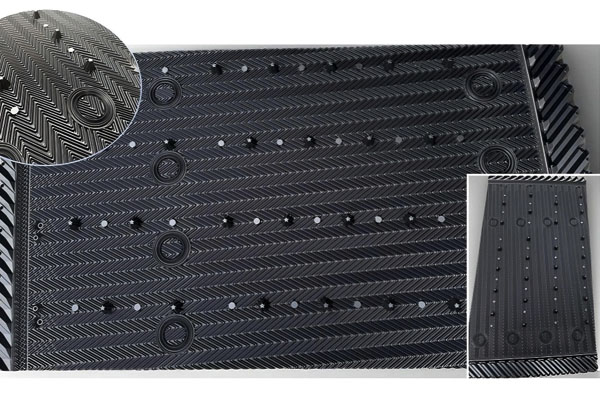
As industrial facilities continue to imp
Selecting suitable cooling tower fill me
How Cooling Tower Fill Design Affects En
When replacing Cooling Tower Fill, many engineers assume that all fill blocks inside the same cooling tower should have exactly the same dimensions.
For a new cooling tower designed from the beginning, this assumption may often be correct.
However, for replacement projects, especially older industrial towers, using identical fill block sizes everywhere is not always the best engineering solution.
The internal structure of a cooling tower is rarely as simple as an empty rectangular space. Beams, columns, pipes, access areas and previous modifications can create different installation zones inside the same tower.
This is why customized Cooling Tower Media dimensions are sometimes necessary to achieve the best balance between cooling performance, installation quality and long-term reliability.
Many replacement projects start with a simple measurement:
Length × Width × Height = Required Fill Volume
Although this calculation is useful, it does not always describe the real installation condition.
Inside an operating cooling tower, there may be:
These details can create different fill sections that require different block dimensions.
Standard Cooling Tower Fill blocks are designed to fit common applications.
They are efficient for many projects because they simplify production and installation.
However, a standard size may create problems when used inside a tower with unusual geometry.
If a standard block is larger than the available space, installers may need to cut the material on site.
Although cutting is sometimes unavoidable, excessive modification can create several issues:
A customized block size manufactured before delivery can often provide a cleaner solution.
The purpose of Cooling Tower Fill is not simply to occupy space.
The internal arrangement determines how air and water move through the tower.
Poorly fitted sections can create unwanted gaps or irregular flow paths.
This may reduce the effective performance of the Cooling Fill system.
A large cooling tower may contain several different zones.
Each zone may have slightly different installation conditions.
The center section usually has the most regular geometry.
Standard fill dimensions may work well in this area.
The tower edges often have different conditions because of walls, air passages or structural limitations.
Smaller or customized fill blocks may be required to achieve proper coverage.
Areas around beams, pipes or access openings often require specially designed fill arrangements.
Trying to force standard blocks into these areas may create unnecessary installation difficulties.
Customized Cooling Tower Fill does not simply mean making a product smaller or larger.
A proper customization process considers:
For crossflow retrofit projects involving different installation widths, a 16.5 Multi-width Cross-flow Fill can be considered where the available space requires different fill dimensions across the tower.
The goal is to create a fill arrangement that works with the existing tower design.
For counterflow applications, the relationship between fill height, water distribution and airflow is especially important.
Products need to maintain the correct air-water contact path.
If the fill arrangement creates unnecessary gaps or uneven sections, the tower may not operate at its expected efficiency.
Crossflow towers have different internal airflow characteristics.
The air enters horizontally through the fill while water moves vertically downward.
For this reason, replacement projects using Cross-flow Cooling Tower Fill should consider the relationship between block arrangement and airflow direction.
Customized dimensions should still follow the correct material requirements.
For example, PVC and PP can be selected according to the operating temperature, water conditions and project requirements.
Changing dimensions does not replace the need for selecting the correct material.
Many industrial cooling towers have been operating for decades.
During their service life, they may have experienced:
The original drawings may no longer represent the actual tower condition.
This is why field measurements and engineering review are valuable before producing replacement Cooling Tower Media.
For a reliable customized solution, engineers normally collect:
These details help determine whether standard fill blocks are suitable or whether different dimensions should be produced.
Some customers think customization always makes a project more complicated.
In many retrofit projects, the opposite is true.
A well-planned customized fill arrangement can reduce:
For towers with several different fill sections, a Multi-Specification Cross Flow Cooling Tower Fill can provide a practical option when different specifications are required within the same retrofit project.
The result is often a smoother installation process.
When modifying the internal arrangement of a cooling tower, other components should also be reviewed.
The fill is only one part of the complete cooling tower system.
A cooling tower replacement project should not always be treated as a simple “remove old fill and install new fill” process.
Every tower has its own internal conditions.
Different fill block dimensions within the same tower can sometimes provide a better engineering solution by improving installation quality, maintaining proper airflow and maximizing the effective cooling area.
The best Cooling Tower Fill design is not always the one with the most standard dimensions.
It is the one that fits the real tower, the real operating conditions and the real installation environment.
Industry trends and cooling tower fill media insights for global customers.
As industrial facilities continue to improve energy efficiency and equipment reliability, cooling to
Winter Operation: Cooling Tower Fill Challenges and Cold-Weather AdaptationsWhy Winter Changes the R
Connect with our team for cooling tower fill media details, project information, and technical assistance.
Chat on WhatsApp