
As industrial facilities continue to imp
Selecting suitable cooling tower fill me
How Cooling Tower Fill Design Affects En
Many engineers consider Cooling Tower Fill replacement as a simple thermal performance improvement. The common expectation is that after installing new fill, the cooling tower will immediately achieve better cooling capacity.
However, a Cooling Tower Fill replacement can influence much more than heat transfer performance. The fill is also a key component that determines how air moves through the tower. When the internal structure of the fill changes, the airflow resistance, fan operating point and energy consumption can also change.
This is especially important during retrofit projects, where a new Cooling Tower Media is installed inside an existing tower with an existing fan system.
A cooling tower works through the interaction between water and air. The fill provides a large contact surface, allowing water to spread into thin layers while air passes through the structure.
However, the fill is not an empty space. Every type of fill creates a certain level of resistance to airflow.
This resistance is influenced by several factors:
Therefore, changing the fill design may change the operating condition of the fan system, even when the tower size remains unchanged.
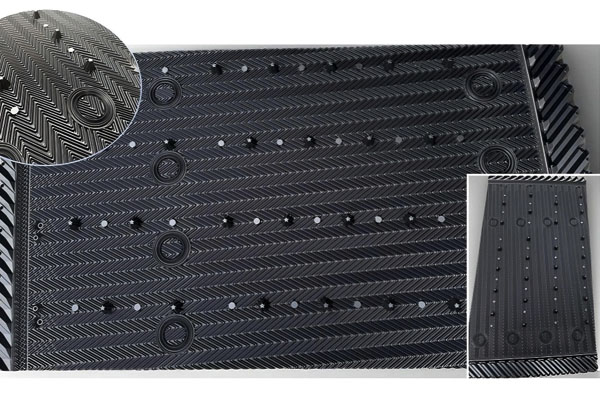
Modern cooling towers commonly use Film Fill because it provides a large surface area for heat transfer.
However, not all Film Fill products create the same airflow condition.
A fill with a more compact structure may provide more contact surface, but it may also create higher resistance for air movement.
A more open structure may reduce pressure drop, but the available heat transfer surface may be different.
This is why engineers should evaluate both thermal performance and airflow characteristics when selecting Cooling Fill.
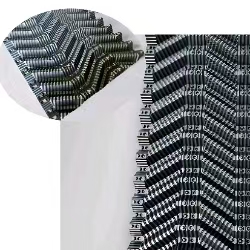
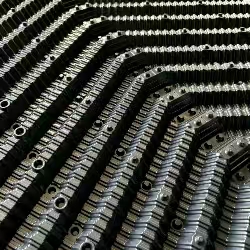
Most modern film-type fills use a corrugated sheet design.
The corrugation creates channels that guide water and air through the fill block.
The angle, spacing and shape of these channels influence:
Two products may have similar external dimensions but different internal structures, resulting in different operating behavior.
When replacing old fill, many engineers focus on whether the new product can provide better cooling.
At the same time, the fan system should also be considered.
The fan was originally selected to operate against a specific resistance from the tower internals.
When the internal resistance changes, the fan operating point may move.
If the new Cooling Tower Fill creates lower airflow resistance, the fan may move more air than before.
This can sometimes improve cooling performance, but it may also change motor operating conditions.
For variable-speed fans, this may provide an opportunity to optimize energy consumption.
If the replacement fill has higher resistance, airflow may decrease.
The tower may still have new and clean fill, but the reduced airflow can limit the expected cooling improvement.
This is one reason why simply choosing the fill with the highest advertised surface area is not always the best engineering decision.
In a counterflow tower, water moves downward while air moves upward through the fill.
The interaction between airflow and fill resistance is especially important because the fan must overcome the resistance created by the entire upward air path.
For replacement projects, engineers often evaluate Counterflow Film Fill based on both cooling performance and compatibility with the existing fan system.
In a crossflow tower, air enters horizontally through the fill while water flows downward.
The airflow pattern is different from counterflow designs.
When replacing Crossflow Film Fill, the fill structure should match the original tower airflow arrangement.
A cooling tower retrofit is not complete when the new fill is installed.
After commissioning, engineers should observe whether the fan system is operating normally.
These measurements help determine whether the new Cooling Tower Media is working together with the existing tower system.
An old fill may not only be dirty. Its internal geometry may have changed after years of operation.
Deposits, deformation and aging can alter the original airflow characteristics.
When a new fill is installed, the airflow condition may return closer to the original design.
This difference can sometimes surprise operators because the fan behavior after replacement may not be exactly the same as before.
The material of the fill should match the operating environment.
For example, PVC and PP may be selected for different cooling tower applications depending on temperature conditions, water quality and expected service life.
Both materials can be used for different cooling tower applications, but temperature conditions, water quality and expected service life should be considered.
Many replacement projects are not simple one-to-one replacements.
Older cooling towers may have:
In these cases, customized fill dimensions can help maintain the correct balance between thermal performance and airflow conditions.
For towers requiring a larger fill width, products such as 1500mm Width Cooling Tower Fill can be considered according to the actual tower dimensions and installation arrangement.
A properly designed replacement is not only about fitting the available space. It is about ensuring that the complete air-water system works correctly.
A fill replacement project is often a good opportunity to inspect other tower components.
Restricted air entry, damaged internal components and changes to the tower's airflow path can all influence the final operating condition of the fan system.
These components should therefore be reviewed as part of the overall retrofit where necessary.
Before selecting a replacement fill, it is useful to collect several basic operating details:
With this information, the new Cooling Fill can be selected based on the actual system instead of only product specifications.
Replacing Cooling Tower Fill is not only a heat transfer improvement project.
The fill is part of the complete airflow system inside the tower, and any change in fill structure can influence fan performance, pressure drop and energy consumption.
The best retrofit result comes from balancing three factors:
A well-selected Cooling Tower Fill should not only improve water cooling efficiency, but also allow the entire cooling tower system to operate more effectively and reliably.
Industry trends and cooling tower fill media insights for global customers.
As industrial facilities continue to improve energy efficiency and equipment reliability, cooling to
Winter Operation: Cooling Tower Fill Challenges and Cold-Weather AdaptationsWhy Winter Changes the R
Connect with our team for cooling tower fill media details, project information, and technical assistance.
Chat on WhatsApp