
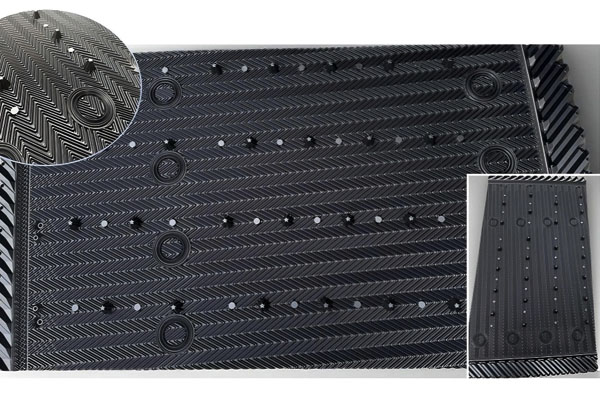
As industrial facilities continue to imp
Selecting suitable cooling tower fill me
How Cooling Tower Fill Design Affects En
Replacing aged fill should be straightforward, but in reality, tower shells from different eras can have varying internal dimensions. Standard off-the-shelf cooling tower fill often doesn't fit exactly, leading to air bypass, water channeling, difficult installation, and wasted investment. Here's a systematic approach to handle dimensional mismatches.
Manufacturers use different fill sheet heights, widths, thicknesses, and layer configurations. Even towers from the same manufacturer may have different internal dimensions after years of operation, maintenance, or modification.
For crossflow applications, the replacement fill must fit the available fill bay while maintaining the intended relationship between water distribution and airflow. A 1010mm × 2500mm Cross Flow Fill for Cooling Tower Applications is one example of a defined dimensional configuration that can be compared with the actual dimensions of an existing tower before replacement.
Never rely only on old drawings. Measure the following on-site:
Provide these measurements, together with photos of the existing installation, to a supplier that offers custom sizing. This allows the supplier to determine whether a standard configuration can be used or whether the fill needs to be manufactured to different dimensions.
For example, if the measured fill bay requires a narrower crossflow configuration, an 870mm Width Cross-flow Fill may be considered when its dimensions match the actual installation space. The important point is to select the width from the tower measurements rather than starting with a product size and trying to make the tower fit it.
Material selection is another consideration during retrofit work, but it should be evaluated together with the tower's operating conditions. PVC and PP cooling tower fill can have different mechanical, thermal, and chemical characteristics, so the choice should take into account water quality, operating temperature, structural requirements, and the existing tower configuration.
When dimensional modifications are required, factory-prepared custom pieces are generally preferable to extensive field cutting. The replacement fill should be manufactured to the required dimensions while remaining compatible with the existing support structure and water distribution arrangement.
A significant gap on one side can allow part of the air to bypass the fill rather than passing through the intended heat-transfer surface. Water may also channel through the gap instead of being distributed evenly across the fill, potentially causing localized scaling or uneven cooling.
Even with high-efficiency film fill, a poor physical fit can reduce the benefit of the fill design. The objective is therefore not simply to make the fill fit inside the tower, but to ensure that it occupies the intended fill area and maintains the designed airflow and water distribution paths.
Use adjustable brackets or compatible support components to compensate for minor level differences where appropriate. If the tower requires a wider fill configuration, select the width according to the measured fill bay and support arrangement rather than filling the remaining space with improvised materials.
For a wider crossflow fill section, a 1520 Width Cooling Tower Fill may be considered when the measured tower dimensions and installation arrangement require this type of width. It should not be selected simply because a wider standard size is available; the actual tower geometry must determine whether the configuration is suitable.
Don't use foam or tape as a permanent solution for significant gaps. These materials can degrade under continuous exposure to water, chemicals, temperature changes, and airflow, and may create additional debris inside the tower.
After installation, check the water distribution pattern. Any unexpected dry spots, concentrated water flow, or visible bypass paths may indicate that the replacement fill is not positioned correctly. Also verify the operating conditions across the fill after the tower returns to service.
If the replacement configuration changes the available airflow path, review the tower's airflow and pressure-drop conditions as part of commissioning. A physically correct installation should still be checked under actual operating conditions to confirm that water and air are moving through the fill as intended.
Retrofitting requires meticulous measurement and, when necessary, custom fabrication. Never assume standard sizes will work simply because the tower uses the same type of fill. Measure the actual fill bay, confirm the support arrangement, and compare the available fill dimensions with the existing installation conditions.
Investing in a proper fit is not only about making installation easier. Correct dimensions help maintain the intended airflow and water distribution paths, allowing the cooling tower fill to perform as designed and reducing avoidable problems during long-term operation.
Industry trends and cooling tower fill media insights for global customers.
As industrial facilities continue to improve energy efficiency and equipment reliability, cooling to
Winter Operation: Cooling Tower Fill Challenges and Cold-Weather AdaptationsWhy Winter Changes the R
Connect with our team for cooling tower fill media details, project information, and technical assistance.
Chat on WhatsApp