
As industrial facilities continue to imp
Selecting suitable cooling tower fill me
How Cooling Tower Fill Design Affects En
Choosing cooling tower fill without considering its air-side pressure drop is a classic mistake. A high-efficiency film fill may improve heat transfer, but if it creates excessive air resistance, the overall energy cost can increase. This article explains how to balance fill performance with fan power.
Every fill type has a characteristic relationship between pressure drop (ΔP) and air velocity. Fill geometry, air velocity, water loading, and fouling all influence the actual resistance through the fill.
For applications where low air resistance is a priority, Splash Grid Fill for Cooling Tower Applications can be considered because its open structure can provide relatively low airflow resistance. The trade-off is that splash-type fill generally provides a different heat-transfer mechanism from film fill, so pressure drop and thermal performance should be evaluated together.
Material itself is not the only factor determining pressure drop. Surface geometry, corrugation, pitch, thickness, fouling, and operating conditions can have a greater influence on air resistance than simply whether the fill is made from PVC or PP.
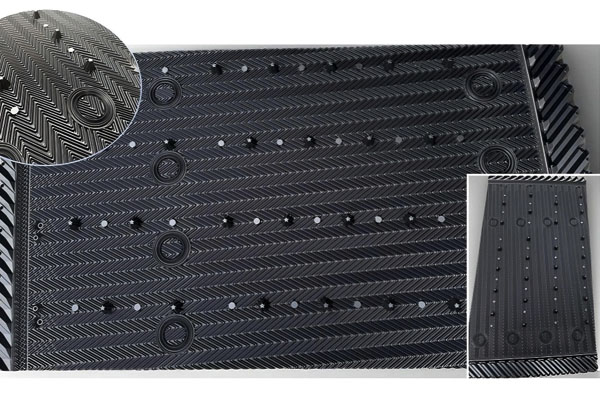
For example, a structured fill such as 1200mm Double-Ripple Cooling Tower Fill should be evaluated according to its actual geometry and operating conditions rather than assuming that one material automatically produces lower ΔP. The fill structure needs to provide the required water distribution and heat-transfer area without creating unnecessary airflow resistance.
The fan must operate at the intersection of its performance curve and the tower's total system resistance (fill + louvers + eliminators + ductwork). If the fill ΔP is too high, the fan may move less air or operate away from its optimum efficiency point. In extreme cases, the additional system resistance can contribute to motor overload.
An increase in fill ΔP does not translate into a fixed percentage reduction in airflow because the final result depends on the complete fan and system curves. However, excessive fill resistance can reduce airflow and therefore reduce the tower's effective cooling capacity.
So a fill that promises higher thermal efficiency is not automatically the best overall choice. If its additional air resistance requires significantly more fan power, the energy balance may become less attractive.
When ordering custom fill, provide the existing fan's rated airflow, static pressure, motor power, and operating conditions. The supplier can then evaluate whether the selected fill geometry is compatible with the available fan operating window.
For crossflow towers with different installation widths, a Multi-width Glue/Hang Dual-purpose Cross-flow Fill can be considered when the fill configuration needs to match different tower dimensions and installation methods. The final selection should still be based on the required airflow, water loading, dimensions, and pressure-drop characteristics.
An HVAC contractor planned to replace a 55 kW motor when switching to denser film fill. After reviewing the complete fan and system requirements, they selected a fill configuration with lower additional air resistance, allowing the existing 45 kW motor to remain in service while still meeting the required cooling duty.
The lesson is simple: before upgrading a fan motor, calculate the complete system resistance. A different fill configuration may solve the airflow problem without requiring a larger motor.
Always check the pressure-drop characteristics of any fill you consider and compare them with the fan's available operating range. A fill with higher thermal performance is not necessarily the best overall solution if its additional air resistance creates excessive fan energy demand.
When selecting cooling tower fill, evaluate heat transfer, airflow resistance, water distribution, fill geometry, and maintenance conditions together. The best fill is the one that delivers the required cooling performance without creating unnecessary resistance in the complete tower system.
Industry trends and cooling tower fill media insights for global customers.
As industrial facilities continue to improve energy efficiency and equipment reliability, cooling to
Winter Operation: Cooling Tower Fill Challenges and Cold-Weather AdaptationsWhy Winter Changes the R
Connect with our team for cooling tower fill media details, project information, and technical assistance.
Chat on WhatsApp