
As industrial facilities continue to imp
Selecting suitable cooling tower fill me
How Cooling Tower Fill Design Affects En
In modern industrial cooling systems, the design of Cooling Tower Fill plays a major role in overall heat transfer performance. Many customers focus on fan capacity or pump flow rate, but the internal fill structure is also a key factor affecting cooling efficiency.
Among different cooling tower media designs, Corrugated Fill has become a popular solution because it can improve water distribution, increase air-water contact, and maintain a practical balance between cooling performance and airflow resistance.
For cooling tower users in Southeast Asia, the Middle East, and other industrial markets, understanding how corrugated structures work can help customers make better decisions for both new projects and replacement applications.
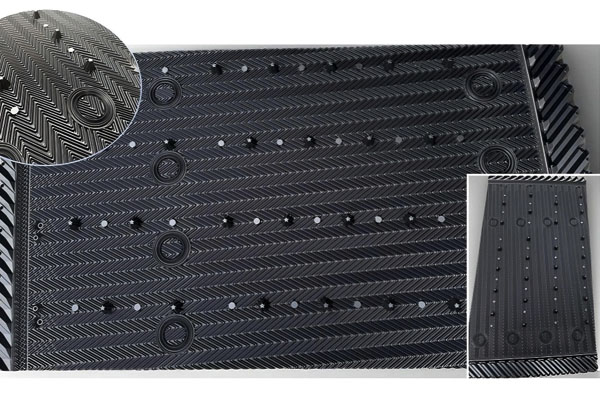
Corrugated Fill is a structured type of cooling tower fill manufactured with specially shaped sheets. The corrugated pattern changes the direction of water and airflow, creating better contact conditions for heat exchange.
Unlike a simple flat surface, the structured sheets provide a larger effective contact area. As water flows through the fill, it spreads across the surface while air passes through the channels created by the corrugated structure.
This air-water interaction is the basic process that allows a cooling tower to remove heat efficiently.
A well-designed corrugated structure helps water spread across more of the available fill surface instead of concentrating in a few flow paths.
Better distribution allows more of the fill area to participate in heat transfer and can improve the overall cooling performance of the tower.
The main purpose of Cooling Tower Media is to maximize effective contact between air and water. Corrugated Fill creates a large contact area within a relatively compact installation space.
This can be particularly useful for industrial cooling towers where available space is limited but cooling requirements are high.
Cooling tower design always requires a balance between heat transfer and airflow resistance. If the fill is too dense, pressure loss may increase and place additional demand on the fan.
A properly selected corrugated structure can provide effective heat exchange without unnecessarily restricting airflow.
In counterflow cooling towers, air moves upward while water flows downward. The fill must provide sufficient contact between the two streams while maintaining stable airflow conditions.
For replacement projects, products such as 305/610mm Dual-width Counter-flow Fill can be considered when the existing tower requires a suitable counterflow fill configuration.
In crossflow cooling towers, air enters horizontally while water travels downward through the fill. Water distribution and airflow passage therefore need to work together efficiently.
For towers requiring different installation widths, 16.5 Multi-width Cross-flow Fill can provide a practical option for projects where standard single-width blocks are not an ideal match.
Choosing the correct tower fill is not simply about selecting the product with the highest claimed efficiency. Engineers should consider the complete cooling system conditions.
Different cooling tower applications require different fill structures. Corrugated film fill is generally selected when efficient heat transfer is important, while more open structures may be preferable where water contains significant suspended solids.
For larger replacement projects, Multi-Specification Cross Flow Cooling Tower Fill can be useful when the customer needs more flexibility in fill dimensions for an existing tower.
Every cooling tower has different internal dimensions. During replacement projects, standard blocks may not always fit the existing support structure efficiently.
Before production, customers should confirm fill block length and width, sheet thickness, installation arrangement, and available space. Providing drawings, measurements, or photographs can help the manufacturer determine a more suitable solution.
Even high-performance fill requires regular inspection to maintain effective operation.
Corrugated Fill can provide an effective combination of water distribution, air-water contact, and airflow performance. However, the best fill is not determined by structure alone.
For replacement projects, tower type, water conditions, fill dimensions, and installation space should all be considered together. If customers provide the existing fill dimensions or project drawings before ordering, the manufacturer can help confirm a more suitable Cooling Tower Fill solution and reduce unnecessary installation problems.
Industry trends and cooling tower fill media insights for global customers.
As industrial facilities continue to improve energy efficiency and equipment reliability, cooling to
Winter Operation: Cooling Tower Fill Challenges and Cold-Weather AdaptationsWhy Winter Changes the R
Connect with our team for cooling tower fill media details, project information, and technical assistance.
Chat on WhatsApp